Tether’s investment in Whop is not just another crypto funding headline. It is a much clearer sign that stablecoin issuers are moving beyond trading and into real internet commerce.
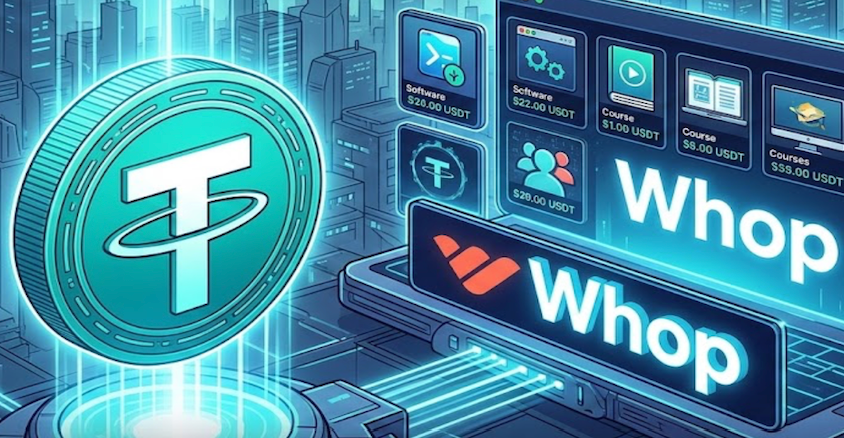
On February 25, Tether announced a strategic investment in Whop, the online marketplace used by creators, entrepreneurs, and digital communities. As part of the deal, Whop will integrate Tether’s Wallet Development Kit (WDK), allowing users to access faster stablecoin payments and self-custodial wallet features directly inside the platform.
That matters because Whop is not a niche crypto app. It is a mainstream internet marketplace where people sell software, memberships, courses, tools, and online services. In other words, this is the kind of place where stablecoins stop being a trading tool and start behaving like payment infrastructure.
This Is More Than a Funding Round
The real story is payment infrastructure
Tether’s official announcement focused less on the funding itself and more on what comes next: integrating stablecoin rails into Whop’s product experience. Users on the platform will be able to choose between USD₮ and USA₮, while Whop uses Tether’s WDK to support faster settlement and self-custodial payments.
That is a bigger shift than it sounds. Many platforms say they “accept crypto,” but that usually means adding one extra checkout option. What Tether and Whop are building looks deeper than that. It pushes stablecoins closer to the core payment layer instead of leaving them as a side feature.
Why Whop is a logical fit
Whop already sits in a part of the internet where payment friction is obvious. Creators sell digital products to users across different countries, currencies, and banking systems. In those markets, fees, delays, chargebacks, and payout restrictions can directly affect whether a business grows or stalls.
That is exactly the kind of environment where stablecoins make the strongest case. If the payment experience becomes faster, cheaper, and more global, the benefit is immediate. It is not theoretical. It shows up in how quickly people get paid.
Why This Matters for the Creator Economy
Stablecoins fit global digital work better than legacy rails
The creator economy is already global by default. A seller can launch a product in one country and find buyers in ten others on the same day. But the payment stack still often feels old: slow withdrawals, high processor fees, and different restrictions depending on where the user lives.
Stablecoins offer a cleaner alternative in cross-border digital business. They move on internet-native rails, settle faster, and reduce reliance on traditional card and bank infrastructure. For creators running smaller, high-frequency online businesses, that can make a real difference.
From platform balances to wallet-based payouts
Another important part of the Whop deal is self-custody. Tether says Whop will use WDK to give users direct control over their funds rather than locking all value inside a traditional platform balance.
That changes the relationship between users and the platform. Instead of waiting for a platform to release money on its own timeline, creators may increasingly receive funds in a wallet they control. That is a meaningful shift, especially for digital entrepreneurs who work across multiple platforms and markets.
The $200 Million Number Matters — But Not for the Obvious Reason
Why the deal size stands out
Tether’s press release did not spell out the dollar amount in the body of the announcement. But public posts and multiple reports tied to Whop’s leadership put the investment at $200 million, with a reported valuation of $1.6 billion.
If that figure holds, the significance is not just that Tether wrote a big check. The real signal is that stablecoin companies are now willing to invest directly in consumer-facing distribution. They are not waiting for merchants to “eventually adopt” crypto on their own. They are buying their way into the payment surface itself.
Distribution is becoming the next stablecoin battleground
Stablecoin competition is no longer only about circulation or market cap. It is increasingly about where these digital dollars actually get used. The more often stablecoins appear in ordinary online income flows, the harder it becomes to see them as tools used only inside crypto.
That is what makes Whop important. It gives Tether a direct route into creator payouts, digital storefronts, community subscriptions, and internet-native business models that already exist at scale.
What X Is Focusing On
The conversation is about usage, not just valuation
Public conversation on X has focused less on the funding headline and more on what the partnership could mean for real-world stablecoin usage. In his post, Tether CEO Paolo Ardoino highlighted Whop’s scale — more than 20 million users and over $3 billion earned by users collectively — framing the deal as a way to bring stablecoin payments deeper into the internet economy. Tether’s official X account took a similar angle, describing the partnership as a push to bring instant, borderless stablecoin payments to Whop’s user base through Tether’s Wallet Development Kit.
That tone matters. The reaction has not centered on hype alone. It has centered on a more specific idea: stablecoins are starting to look less like exchange liquidity and more like internet payment rails.
Why that matters for market narratives
In crypto, the stories that last are usually the ones tied to actual usage. The X discussion around Whop reflects that. Traders and builders are paying attention because this is the kind of deal that pushes stablecoins into everyday commercial behavior, not just on-chain speculation.
Does This Threaten Stripe or PayPal?
Not directly — at least not yet
Stripe and PayPal still dominate mainstream online payments. They have better-established merchant coverage, compliance systems, and customer trust in traditional commerce. Stablecoins are not replacing them overnight.
But they are attacking a weaker part of the market: cross-border, digital-native, fragmented creator income. That is where old payment systems often feel the slowest, the most expensive, or the least flexible.
Where stablecoins can win first
Stablecoins are most likely to gain ground in areas where users care less about legacy banking familiarity and more about speed, payout access, and low-friction transfers. That includes creators, small online teams, software sellers, and AI-native businesses operating globally from day one.
If Whop can make stablecoin payouts feel simple enough, the long-term impact could be bigger than the headline itself. It would show that crypto-based settlement can work in a real business platform without being treated as a niche feature.
What This Means for Crypto Traders
Stablecoins are becoming a bigger macro story
For traders, this deal is another reminder that stablecoins are evolving beyond exchange plumbing. They are becoming part of the broader financial infrastructure of the internet. That makes adoption headlines more important than they used to be.
When stablecoins move into real payment channels, the market often starts repricing what these networks are worth. That does not always lead to immediate price action, but it strengthens the long-term use case behind the sector.
Why it matters on Tapbit
For users following the next wave of crypto utility, this is the kind of development worth tracking closely. You can monitor how the market reacts to stablecoin adoption, payment infrastructure news, and related narratives through Tapbit Price.
Traders looking to stay close to major crypto market moves can also visit the Tapbit homepage, log in through Tapbit Login, or create an account at Tapbit Register.
Conclusion
The next stablecoin growth market may be creator income
Tether’s Whop investment points to a larger shift in crypto. Stablecoins are moving closer to where people actually earn money online. That includes subscriptions, digital products, communities, and small internet businesses that need global payouts to work smoothly.
If this model works, it will not just be a win for Whop. It will be another proof point that stablecoins can function as real payment infrastructure for the internet economy. And that could matter far more than any single funding round.
Disclaimer: This article is for informational and educational purposes only and does not constitute investment advice. Markets can move sharply during geopolitical events, and both commodities and crypto assets carry risk.