
If you are just watching the standard green and red candles on the XRP spot chart right now, you are only seeing half the picture.
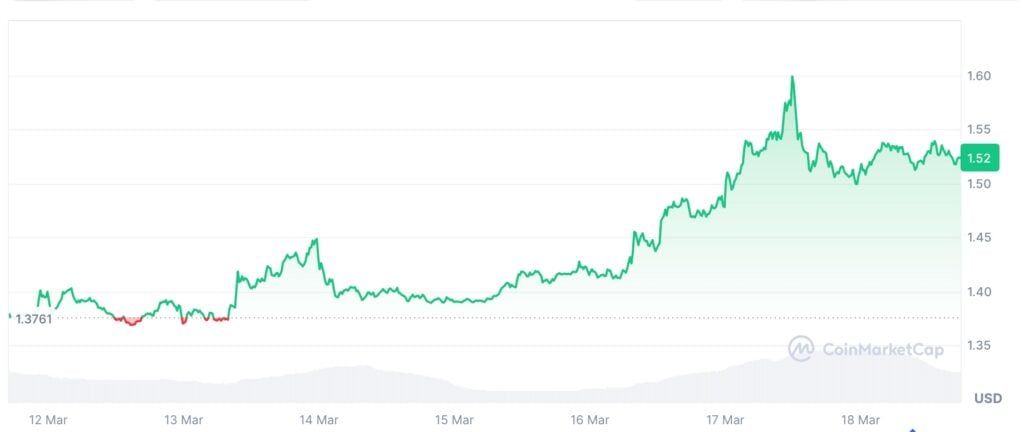
Sure, XRP looks decent hovering around $1.52. It is holding support, riding the broader market momentum as Bitcoin consolidates near $74,000. For a retail spot holder, things look technically sound.
But if you want to know where the explosive, market-moving volatility is hidden, you need to pull up the Deribit options chain. Beneath the surface of today’s quiet trading, a massive derivatives fight is concentrated exactly at the $1.40 strike price, set to expire on March 27.
This isn’t just data; it’s a gravity well.
Here is the Tapbit trading desk breakdown of why $1.40 is the only price that matters for XRP this month, and how this derivatives dynamic will hijack the spot price.
The $14.6 Million Powder Keg
In the options world, open interest—the number of active contracts—is usually spread out. Right now, XRP has a massive anomaly: a hyper-concentration of money sitting on a single number.
There is roughly $14.6 million in open interest clustered exclusively at the $1.40 strike. To put that in perspective, this single price level represents nearly a quarter of all XRP options currently open on the exchange.
It’s a literal battleground:
- Bulls have opened $6.95 million in Calls (betting the price stays up).
- Bears have opened $7.69 million in Puts (betting the price drops).
When 25% of the market is betting on one specific number expiring on March 27, that level stops being a “support line” and becomes a magnet.
The Mechanics of the “Pin”
How does a derivatives strike price hijack the actual market price? It comes down to market makers and a concept called “pinning.”
The institutions that sold these options are “short gamma.” To manage their own massive risk, they are forced to constantly buy and sell spot XRP as the price moves. If the price of XRP starts sliding toward $1.40 as March 27 approaches, these market makers must aggressively short the asset to hedge their exposure.
This algorithmic hedging creates a self-fulfilling prophecy. The closer the price gets to the strike, the harder the market makers force it toward that exact number, effectively “pinning” the price at $1.40 right as the contracts expire.
The Scenarios for March 27
Right now, the bulls are comfortably winning. By keeping the price well above $1.50, they are forcing that massive $7.69 million put cluster to expire worthless. If XRP can hold this altitude through March 27, the market makers will unwind their short hedges, potentially fueling a major relief rally.
However, in the options market, gravity usually kicks in the closer we get to the deadline.
If the broader crypto market takes a dump, and XRP slips through local support at $1.45, the trapdoor opens. Algorithmic hedging will likely accelerate, violently dragging the price down to that $1.40 magnet to settle the contracts.
Volatility isn’t just possible here; it is mathematically guaranteed.
How to Position Your Portfolio on Tapbit
This is an event-driven setup. You should not be blindly holding spot XRP without a plan for this expiry.
- Set Your Limit Bids: Market makers are forced to defend that $1.40 level once it hits. If you are a long-term holder, place laddered spot limit buys in the $1.38 to $1.42 range. If the market flushes, you will likely catch the exact bottom of the “pinning” wick before it bounces.
- Trade the Volatility: Watch that $1.45 level closely. If it breaks with high volume, consider using Tapbit’s perpetual futures to ride the market-maker hedging wave down to $1.40.
- Don’t Be the Exit Liquidity: Log in to Tapbit to access ultra-low latency derivatives execution, or Register your free account today to ensure your limit orders trigger with zero slippage during the expiry chaos.
Disclaimer: This article is for educational and informational purposes only and does not constitute financial advice. The cryptocurrency market carries extreme volatility and smart contract risks. Always conduct independent research before deploying capital or utilizing automated trading tools.