

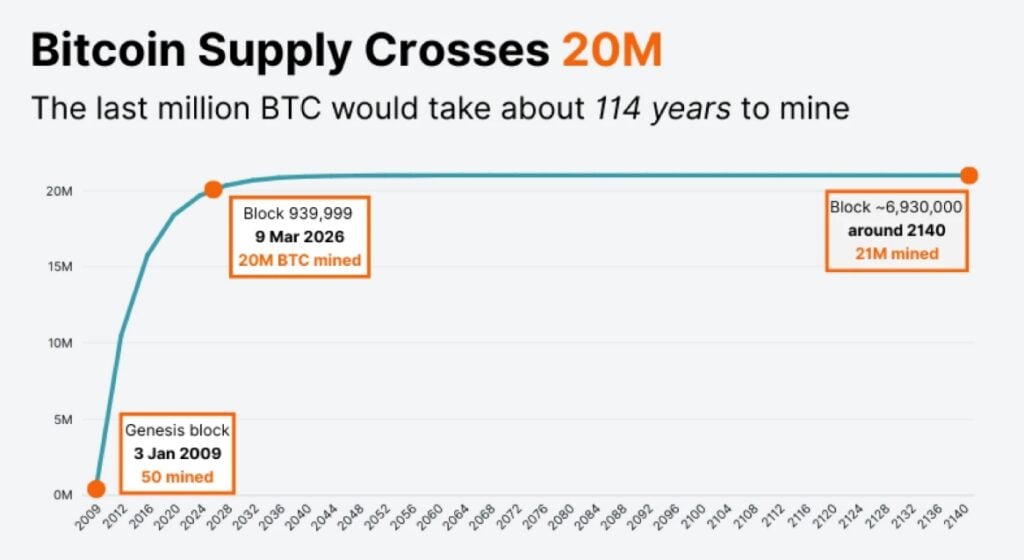
On March 9, 2026, the Bitcoin network quietly hit a massive milestone. At block height 939,999, the 20 millionth Bitcoin was officially mined.
If you’re keeping track of the math, that means over 95% of the total 21 million Bitcoin supply cap is now out in the wild.
It took just over 17 years for miners to generate those first 20 million coins. But because of how Bitcoin’s code is written, mining the final 1 million coins is going to take more than a century.
For traders on Tapbit, this isn’t just a fun trivia fact. It’s the foundation of a major liquidity squeeze. Here is a realistic look at what happens to the market when the supply of new Bitcoin effectively grinds to a halt.
The 114-Year Wait for the Last Million
To understand why the final 5% is such a big deal, you have to look at the halving mechanism.
Satoshi Nakamoto heavily front-loaded Bitcoin’s issuance. Back in 2009, miners received 50 BTC for every block they solved. Today, after four halving events, that reward sits at just 3.125 BTC per block. Every four years, the amount of new Bitcoin entering the market gets slashed in half.
Right now, roughly 450 new BTC are mined each day. After the next halving in April 2028, that number drops to 225. Because this deceleration compounds, it will take roughly 114 years—until the year 2140—to mine the very last fraction of a Bitcoin.
We have officially transitioned from the era of Bitcoin creation to the era of absolute scarcity.
The “Ghost” Supply: Why 20 Million is an Illusion
Here is the detail most headlines miss: there aren’t actually 20 million Bitcoin available to buy.
Unlike fiat money, if you lose your Bitcoin, nobody can print a replacement. During Bitcoin’s early years, the coin was practically worthless. People mined thousands of BTC on old laptops and then threw the hard drives away. People forgot passwords. Early adopters passed away without giving anyone their seed phrases.
Blockchain analytics firms estimate that somewhere between 2.3 million and 3.7 million BTC are permanently lost. If you subtract that “ghost supply” from the total, the reality of the market becomes a lot more aggressive:
- Maximum Cap: 21,000,000 BTC
- Mined So Far: 20,000,000 BTC
- Permanently Lost (Est.): ~3,000,000 BTC
- Actual Liquid Supply: ~17,000,000 BTC
The true supply is shrinking, not growing. Every time someone loses a hardware wallet today, the asset becomes mathematically scarcer for everyone else.
The Wall Street Collision
Scarcity doesn’t matter if nobody wants to buy the asset. But in 2026, demand is ripping through the roof.
We are currently watching a head-on collision between a shrinking daily supply (450 BTC) and massive institutional buying power. Throughout early March 2026, U.S. spot Bitcoin ETFs were routinely pulling in hundreds of millions of dollars in a single day. At the same time, corporate buyers like MicroStrategy are still sweeping up billion-dollar chunks of the circulating supply.
Wall Street is trying to accumulate an asset where 95% of the supply is already distributed, and the remaining 5% is being aggressively throttled. When heavy institutional demand meets an immovable supply cap, the market is forced to reprice upward to find sellers.
How to Trade the Supply Squeeze on Tapbit
As the daily issuance of Bitcoin continues to drop, market volatility is guaranteed to spike. Big players fighting over a shrinking pool of available coins creates massive trading opportunities.
Tapbit is built to handle exactly this kind of high-stakes market environment.
- ➡️ Secure Your Spot Position: Log in to Tapbit to buy and hold BTC with deep liquidity and zero slippage.
- ➡️ Leverage the Volatility: Use Tapbit’s advanced perpetual contracts to trade the price swings caused by ETF inflows and supply shocks.
- ➡️ Just Getting Started? Register your free Tapbit account today and get access to the pro-level trading tools you need to navigate the crypto market.
Frequently Asked Questions (FAQ)
What does it mean that 20 million Bitcoin are mined?
It means that out of the maximum 21 million Bitcoin that can ever exist, over 95% have already been created. There is only 1 million left to mine.
When will the last Bitcoin be mined?
Because the network cuts the mining reward in half every four years (the halving), the final 1 million Bitcoin will take over a century to produce. The last coin is expected to be mined around the year 2140.
How many Bitcoin are lost forever?
Experts estimate that around 3 million Bitcoin are permanently lost. This happens when people lose their private keys, forget their passwords, or send coins to dead addresses. Because of this, the actual circulating supply is much lower than 20 million.
What happens to miners when all 21 million are mined?
Once no new Bitcoin can be created, miners will survive entirely on transaction fees. Every time someone sends Bitcoin, they pay a small fee. By 2140, these fees are expected to fully fund the security of the network.
Does this make Bitcoin scarcer than gold?
In terms of supply growth, yes. Currently, the amount of new gold mined each year adds about 1.5% to 2% to the total supply. Bitcoin’s current annual supply growth is around 0.85%, and it will drop again at the next halving in 2028.
Disclaimer: This article is for educational and informational purposes only and does not constitute financial advice. The cryptocurrency market carries extreme volatility. Always conduct your own research before deploying capital on Tapbit or any other platform.