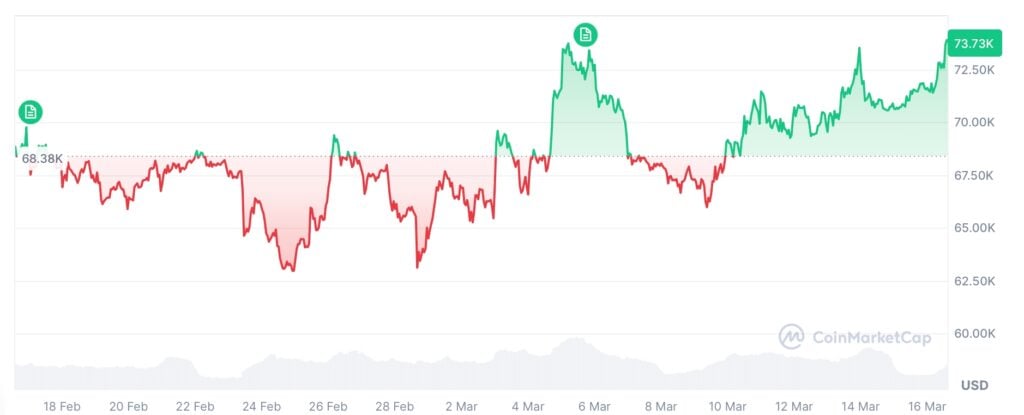
For the last two weeks, the $74,000 level has acted as an iron ceiling, violently rejecting every breakout attempt. But on Monday morning, that defense line finally broke.
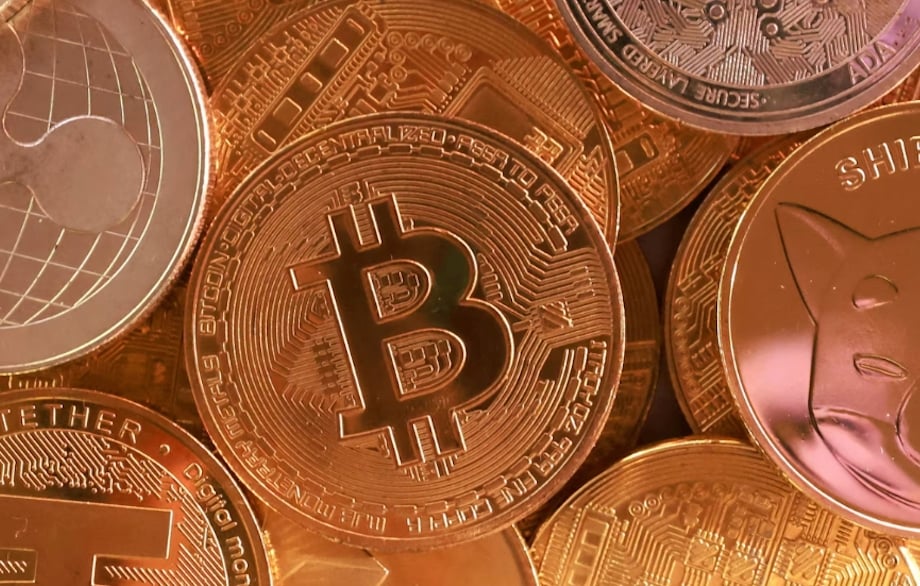
Bitcoin briefly pierced the $74,000 resistance zone, instantly igniting bullish sentiment across the entire crypto market. Currently consolidating in the $70,900 to $74,000 range based on live spot data, BTC has secured a solid 9.7% weekly gain.
However, if you are only watching Bitcoin right now, you are missing the actual signal.
The most important takeaway from Monday’s price action was not Bitcoin’s breakout—it was the massive outperformance of major altcoins. Capital is no longer just hiding in BTC as a safe haven; risk appetite has genuinely returned. Here is the Tapbit research desk breakdown of the short squeeze, the geopolitical pivot, and the massive Federal Reserve hurdle waiting later this week.
The Squeeze: $280 Million in Shorts Liquidated
Markets rarely break heavy resistance without causing immense pain. Monday’s surge was fundamentally a bloodbath for the bears.
As Bitcoin shoved past $74,000, it triggered a cascading short squeeze across derivative markets. According to CoinGlass data, over 91,000 traders were liquidated in a 24-hour window, wiping out $344 million. The capital structure was severely lopsided: roughly 83% of those liquidations ($284.9 million) were short positions. On Bitfinex alone, a single trader suffered a massive $6.94 million BTC liquidation.
Interestingly, Bitcoin was not even the primary victim of the squeeze. Ethereum shorts took the heaviest damage, wiping out nearly $127.9 million, closely followed by Bitcoin ($124.5 million) and Solana ($18.5 million). This confirms that speculative capital had been aggressively betting that a toxic macro environment would crush high-beta assets like ETH. The market aggressively corrected that assumption.
Capital Rotates Down the Risk Curve
The liquidation data perfectly matches the capital rotation we are seeing on the spot order books. Money is actively rotating down the risk curve.
- Ethereum (ETH): Surged 7.7% daily to tap $2,261, booking a 14.3% weekly gain—its strongest performance in months.
- Solana (SOL): Jumped over 5% on the day, reclaiming the $93 level with a 12% weekly gain.
- Dogecoin (DOGE): Reclaimed the psychological $0.10 mark for the first time since early March.
- BNB & XRP: Both posted solid 4% daily gains, pushing their weekly returns near double digits.
When ETH outperforms BTC by 4.6 percentage points on a weekly basis, and SOL outperforms by 2.3 points, the market logic is clear: traders are confident enough to chase higher beta returns. This is the classic signature of a genuine altcoin rotation.
The Macro Catalyst: Easing Oil and a Weaker Dollar
You cannot trade this current crypto market without watching the geopolitical board. The immediate catalyst for Monday’s surge was not a blockchain upgrade—it was a sharp de-escalation in the Middle East.
For weeks, tensions surrounding the Strait of Hormuz have choked global liquidity, driving up oil prices and strengthening the U.S. Dollar. Over the weekend, the narrative shifted. Following reports of potential dialogue between the U.S. and Iran, Iranian officials softened their rhetoric. More importantly, two commercial tankers successfully sailed through the strait on Sunday—the first commercial transit since the conflict escalated.
Global markets reacted instantly. Brent crude, which had spiked over $106.50, pulled back down to the $104 range, while WTI dropped below $100. The U.S. Dollar (DXY) weakened by 0.3%, and equities stabilized. For crypto, cooling oil + a weaker dollar = the perfect liquidity release valve.
The Final Boss: The Fed’s March Meeting
Geopolitical easing set the stage, but the Federal Reserve will determine if this rally survives the week.
On March 17-18, the Fed convenes for its highly anticipated policy meeting. Just a week ago, with oil prices rocketing toward $110, the market was terrified that surging energy inflation would force the Fed to abandon its 2026 rate cut projections.
With oil pulling back, that inflation calculus has changed. All eyes are now on Jerome Powell’s Wednesday press conference and the release of the updated “dot plot.” If Powell acknowledges the cooling macro pressures and keeps rate cuts on the table, this altcoin rotation will likely accelerate into a full-blown trend. If he stays stubbornly hawkish, expect a brutal retest of Monday’s lows.
Execute Your Weekly Strategy on Tapbit
We are entering a 48-hour window of extreme macroeconomic volatility. Execution speed is critical.
- ➡️ Capture the Rotation Alpha: Log in to Tapbit and closely monitor the ETH/BTC and SOL/BTC trading pairs. If they continue to show relative strength, use Tapbit’s deep spot liquidity to position yourself in top-tier Layer 1 assets.
- ➡️ Manage Event Risk: Wednesday’s Fed decision guarantees violent wicks in both directions. Utilize Tapbit’s advanced perpetual contracts to set strict stop-loss and take-profit orders. Do not trade the news blind.
- ➡️ New to the Platform? Register your free Tapbit account today to access the institutional-grade matching engine required to trade this market without slippage.
Frequently Asked Questions (FAQ)
What is a “Short Squeeze”? A short squeeze occurs when an asset’s price unexpectedly rises, breaking key resistance levels. Traders who had bet against the asset (short sellers) are forced to buy it back to close their positions and prevent further losses. This forced buying creates a feedback loop that pushes the price even higher. Monday saw $280 million in short positions liquidated to fuel the rally.
Why does the Strait of Hormuz affect Bitcoin? The Strait of Hormuz is the world’s most critical oil transit chokepoint. Conflicts there cause oil prices to spike, which drives up global inflation. High inflation forces the Federal Reserve to keep interest rates high, draining liquidity from financial markets—a highly bearish scenario for risk assets like Bitcoin. When tensions cool, oil drops, and crypto thrives.
What does it mean when capital “rotates down the risk curve”? During market panics, investors move capital into the safest, largest assets (like Bitcoin). When confidence returns, they move that capital into smaller, more volatile assets (like Ethereum, Solana, and altcoins) to capture higher percentage gains. This is known as rotating down the risk curve.
Why is this week’s Federal Reserve meeting critical? This meeting includes the release of the “dot plot,” a chart showing where Fed officials expect interest rates to be in the coming years. If the Fed signals that they still plan to cut rates in 2026, it will provide massive tailwinds for crypto. If they signal rates will stay high for longer, the market will likely correct downward.
Disclaimer: This article is for educational and informational purposes only and does not constitute financial advice. The cryptocurrency market is heavily influenced by macroeconomic and geopolitical events, carrying extreme volatility risk. Always conduct independent due diligence before executing trades on Tapbit or any other platform.