
Updated: March 2026
Prediction markets used to feel like a side corner of crypto — interesting during elections, fun during sports, and mostly invisible to everyone else.
Over the last few days, Polymarket has looked less like a niche betting app and more like a live geopolitical sentiment engine. Once the Iran story escalated, traders piled into those markets so aggressively that it stopped looking like curiosity and started looking like real-time risk pricing.
And that is what makes this worth paying attention to. Markets like this may not always be “right,” but they are increasingly showing what the crowd believes before the rest of the market has fully processed it.
If you trade fast narratives, that matters. You can keep an eye on cross-market sentiment and broader crypto rotation on Tapbit.
The Iran Shock Turned Polymarket Into a Real-Time Sentiment Dashboard
This Was Not a Normal News Spike
The Iran-related frenzy on Polymarket has already moved beyond “big for crypto” territory.
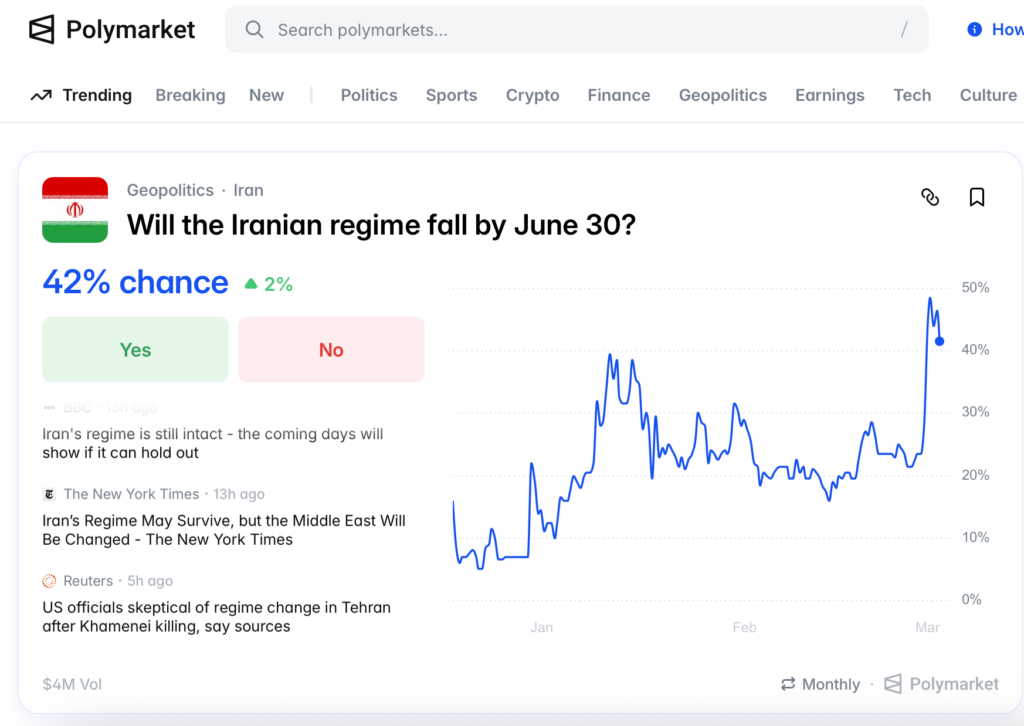
At this point, it is big enough to force a broader question: are prediction markets becoming part of how people actually process geopolitical risk?
The raw numbers make that question hard to ignore. Once a single geopolitical theme can drive this much money through one platform, the old “this is just niche crypto gambling” dismissal starts to sound lazy.
Why This Matters More Than Just Volume
What matters to me is not only that the volume was huge. It is that the market moved fast enough to make Polymarket feel like a public probability feed, not just a place to make speculative bets.
Traditional news tells you what happened. A prediction market gives you a moving price on what people think is likely to happen next.
That is a very different kind of signal. And in an environment where timing matters, that kind of signal becomes surprisingly powerful.
February Changed the Scale of the Entire Prediction-Market Story
Polymarket Is No Longer Small Enough to Ignore
The Iran markets are the dramatic headline, but the bigger backdrop is that Polymarket was already scaling hard before this story exploded.
By the time the Iran-related betting frenzy hit, the platform had already moved into a much bigger league of relevance. Once a product starts doing monthly volume at this scale, it stops being easy to dismiss as an online curiosity.
This is the point where a lot of people will realize they are late to the story: prediction markets are not “coming.” They are already large enough to matter.
What That Says About User Behavior
People clearly do not just want to read headlines anymore. They want to trade probability itself. That is really what products like Polymarket are selling: not journalism, not fundamental research, but a public market for uncertainty.
Why Polymarket Keeps Winning So Much Attention
It Turns Narrative Into Price Almost Instantly
Polymarket’s real product advantage is simple: it turns a messy, emotional, headline-driven situation into something with a visible price.
Wars, elections, court decisions, resignations, sports outcomes — all of it becomes tradable. And once that happens, the platform stops feeling like a passive information product. It starts feeling like a live consensus machine.
That is an incredibly addictive product structure in a market culture built around speed.
It Feels Closer to Live Crowd Belief Than Traditional Commentary
This does not mean prediction markets are always more accurate than reporting. They are not. But they often show where the crowd is leaning faster than more traditional commentary formats do.
That is why Polymarket increasingly feels less like a betting site and more like sentiment infrastructure.
And once a product becomes part of how traders monitor “what the crowd thinks right now,” it becomes much harder to ignore.
What X Is Saying About the Iran Betting Frenzy
The Social Reaction Has Been Split Between Awe and Suspicion
The reaction on X has been almost as revealing as the volume itself.
Some accounts are treating this as a turning point for prediction markets. The strongest version of that argument is basically: Polymarket is no longer just a niche crypto venue — it is becoming a place where public probabilities get priced faster than traditional commentary can keep up.
You can see that in how Polymarket’s own account leaned into the moment, posting rapid-fire updates tied to the Iran story and effectively reinforcing the idea that the platform itself is a live event stream with prices attached.
That fits what many traders saw in real time: the market did not wait for polished analysis. It moved first, and then the rest of the internet tried to explain it afterward.
But the Other Side of X Focused on Something Less Comfortable
At the same time, another type of post started circulating quickly: not “this is the future,” but “who got in early, and how did they know?”
Cointelegraph’s X post amplified the idea that a small group of traders made roughly $1 million on the “US strikes Iran” market. Dustin Gouker, who has followed betting and prediction-market infrastructure for years, also highlighted the scale of the market and the significance of its resolution. Meanwhile, wallet-watch and trader-focused accounts such as EyeOnChain focused more on profits, timing, and unusual behavior than on the platform’s long-term product narrative.
That split tells you a lot. On one side, X sees Polymarket as the fastest public sentiment layer on the internet. On the other, it sees the exact same event as proof that once enough money is involved, prediction markets inherit the same trust problems every serious market eventually runs into.
If I had to sum up crypto X in one line, it would be this: Polymarket looked like two things at once — the fastest public market for uncertainty on the internet, and a reminder that fast markets attract sharp players even faster.
Where Hedgehog Fits In
Polymarket Owns Mindshare, but Hedgehog Has a Different Pitch
If Polymarket is the dominant name right now, Hedgehog is one of the more interesting challengers because it is trying to solve a different problem.
It is Solana-native, and that matters. The value proposition is not “we are bigger.” It is “we are faster, cheaper, and closer to how crypto-native users already trade.”
That is a real distinction in this category. For a lot of users, especially those who already live in Solana-native workflows, speed and friction matter just as much as brand recognition.
Why Traders Should Watch It
Polymarket is where the crowd goes. Hedgehog looks more like where speed-first users may increasingly want to trade if they care about execution and staying inside a faster, cheaper on-chain environment.
That does not make Hedgehog the leader. Not yet. But if the prediction-market category keeps scaling, second-tier platforms with better execution or tighter ecosystem fit are going to matter a lot more than they do now.
My Take
Prediction Markets Are Becoming Sentiment Infrastructure
The easiest way to describe Polymarket is still “a crypto betting platform.” That used to be enough. It is not enough anymore. What is changing in 2026, in my view, is that prediction markets are becoming something much more important: a live layer of public sentiment pricing. They do not replace journalism. They do not replace real research. And they definitely do not eliminate the need for judgment.
But they do something very specific that almost nothing else does as cleanly: they turn uncertainty into a tradable public price, in real time, with real money behind it.
That makes them messy. It makes them controversial. It also makes them impossible to ignore.
Why This Matters for Crypto Traders
If you trade narratives, this changes where “market truth” starts forming. The first signal does not always come from price charts anymore. Sometimes it comes from event markets, where users are pricing probabilities before the rest of the market has fully reacted. That does not mean you blindly trust those markets. It means you learn to watch them the same way you watch funding, macro headlines, positioning, and sentiment.
For Tapbit users, that is the practical takeaway: prediction markets are no longer just a side curiosity. They are becoming part of the broader information stack that active traders can learn from. If you are building a market view across crypto, macro, and politics, staying plugged into fast-moving sentiment through Tapbit becomes more useful, not less.
If you want to stay ready for fast narrative shifts, you can create an account through Tapbit Register, return to your dashboard via Tapbit Login, or recover access anytime through Tapbit Password Recovery.
Final Take
Polymarket Is No Longer Easy to Dismiss
The Iran betting frenzy did not just create a flashy headline. It marked a shift in how prediction markets are being perceived. At this scale, they are no longer just entertainment for crypto natives. They are becoming part of how the internet prices uncertainty in public.
That is the opportunity. But it is also the challenge.
The bigger these markets get, the more they will be judged not only on speed and volume, but on fairness, trust, and whether they can handle the kind of scrutiny that comes with becoming genuinely important. And that is why this matters: Polymarket may not just be a betting site anymore. It may be turning into one of the internet’s first real-time public markets for uncertainty itself.
Disclaimer: This article is for informational and educational purposes only and does not constitute investment advice. Event-based markets and crypto markets both involve substantial risk, and major geopolitical events can increase volatility and uncertainty dramatically.