

The intersection of global geopolitics and digital assets has taken center stage in March 2026. Over the past few weeks, global financial markets have been violently reshaped by the escalating military conflict involving Iran and Israel, leading to severe disruptions around the Strait of Hormuz—the world’s most critical energy chokepoint.
While cryptocurrency traders usually focus on on-chain metrics and tokenomics, the current market is being entirely dictated by a traditional commodity: Crude Oil.
With West Texas Intermediate (WTI) crude experiencing historic volatility, the macroeconomic landscape for risk assets like Bitcoin (BTC) is shifting by the hour. Here is a definitive breakdown of the 2026 oil shock, supported by real-time market data, and what traders should anticipate next.
1. The Anatomy of the 2026 Oil Shock
The Strait of Hormuz facilitates the transit of roughly 20% of the global oil supply. Recent strikes on Iranian infrastructure and subsequent threats to this waterway triggered a massive supply panic.
- The Parabolic Spike: Earlier this week, WTI crude prices went parabolic, surging to a high of $119.48 per barrel—levels not seen since the immediate aftermath of Russia’s 2022 invasion of Ukraine.
- The Dramatic Reversal: The market quickly experienced a sharp reversal, pulling WTI back down to the $89 – $93 range. This decline was catalyzed by the International Energy Agency (IEA) approving a historic release of emergency oil reserves. Member states coordinated a 400-million-barrel dump, including 172 million barrels from the US and 80 million from Japan, to artificially suppress the price spike.
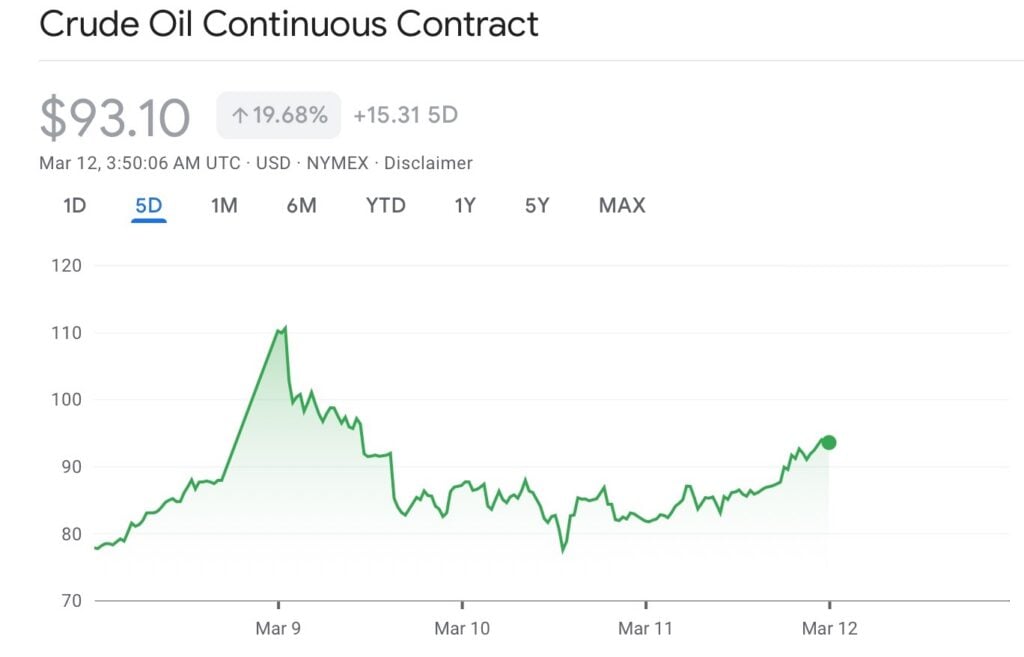
Despite this pullback, the market remains on a knife-edge. As long as absolute guarantees against future strikes are absent, the fundamental geopolitical risk premium remains priced into the charts.
2. The Macro Spillover: Why Oil Dictates Crypto Liquidity
Many of you may ask: Why does a conflict in the Middle East and the price of gasoline affect my Web3 portfolio? The answer lies in the transmission mechanism of inflation.
Bitcoin and the broader cryptocurrency market operate as “high-beta” risk assets. They require excess market liquidity to sustain aggressive bull runs. That liquidity is entirely controlled by the US Federal Reserve’s interest rate policy.
- The Inflation Threat: When oil surges violently, energy costs bleed into every sector of the global economy—from manufacturing to global shipping. This drives up headline Consumer Price Index (CPI) inflation.
- The Fed’s Dilemma: If inflation rebounds due to a sustained $100+ oil price, the Federal Reserve will be forced to abandon its 2026 interest rate cuts. Policymakers may even be forced to float the idea of resuming rate hikes to combat stagflation.
- The Crypto Impact: Higher interest rates strengthen the US Dollar (DXY) and drain risk-on capital from the markets. If traditional investors can earn a guaranteed high yield on government bonds, their appetite for volatile digital assets drops significantly.
3. What’s Next? Two Scenarios for Digital Assets
Currently, Bitcoin is consolidating tightly near $69,437.10. It is refusing to break down, but it lacks the macro tailwinds to break out. Moving forward, traders should prepare for two distinct scenarios based on the resolution of the energy crisis:
Scenario A: The Ceasefire & Liquidity Flush (Bullish)
If diplomatic channels succeed and the Strait of Hormuz fully reopens without further military escalation, the geopolitical risk premium on oil will evaporate. WTI crude will likely crash back toward its fundamental $70-$75 range.
- The Result: The threat of an inflation resurgence dies. The Fed receives the green light to proceed with aggressive rate cuts, weakening the dollar. Bitcoin and major altcoins will likely absorb a massive wave of sidelined capital, triggering a breakout toward new all-time highs.
Scenario B: Prolonged Disruption & Stagflation (Bearish/Rotational)
If peace talks fail and commercial vessels continue to face threats, the IEA’s emergency reserve releases will only act as a temporary band-aid. Once depleted, oil could easily re-test the $115+ mark.
- The Result: The market enters a stagflationary environment. Institutional capital will flow into traditional safe havens like Gold and the US Dollar. For crypto, Bitcoin may face a slow liquidity bleed. However, agile capital will likely rotate aggressively into specialized, narrative-driven altcoin sectors—such as AI compute tokens or Real World Assets (RWA)—that can generate independent momentum despite macro headwinds.
Execute Your Macro Strategy on Tapbit
In a market environment where a single geopolitical headline can swing energy prices 10% and instantly re-price Bitcoin, having access to institutional-grade trading infrastructure is non-negotiable.
You need a platform that offers zero-latency execution to ensure your stop-losses hit and your limit orders fill during periods of extreme volatility.
- ➡️ Ready to trade the geopolitical rotation? Register your free Tapbit account today to access deep liquidity across spot and derivatives markets.
- ➡️ Already positioned? Log in to Tapbit to analyze the real-time BTC/USDT order books and refine your risk management strategy.