

Updated: March 2026
When markets get hit by a real geopolitical shock, people stop debating theories and start reaching for whatever feels safest.
That is why the last few days have been so revealing. Gold moved the way a classic safe-haven asset is supposed to move: quickly, cleanly, and with very little hesitation. Bitcoin, on the other hand, did what it often does in a real stress event — it sold off first, then tried to stabilize once the first wave of panic passed.
That does not mean Bitcoin is “broken.” It does mean the market still treats these two assets very differently when the headlines stop being abstract.
If you trade around macro shocks, this is exactly the kind of moment worth paying attention to. You can follow broader cross-asset sentiment and crypto market moves on Tapbit, and if you are already positioned, you can get back to your account through Tapbit Login.
Gold Did What Safe Havens Are Supposed to Do
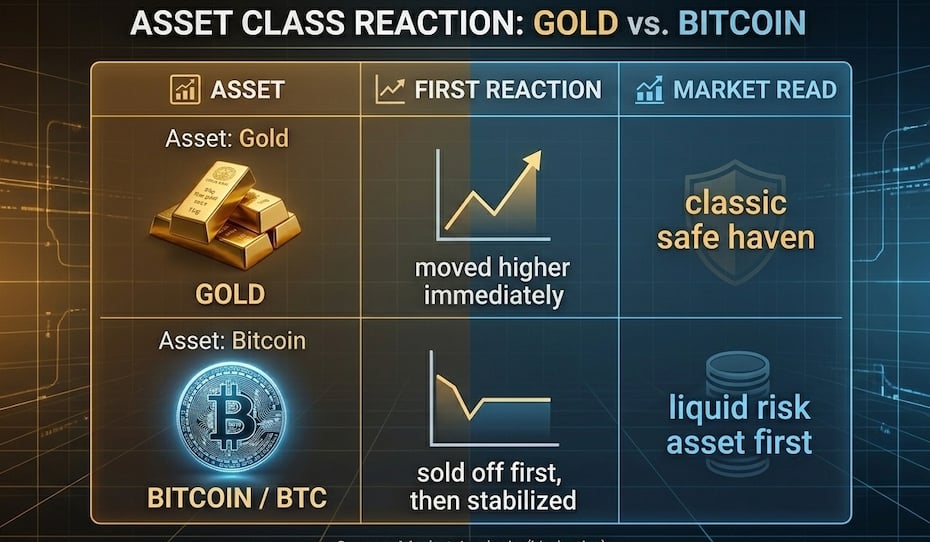
The First Move Went to Gold
The cleanest way to judge a real safe haven is to watch what happens in the first move, not the second.
And in this case, the first move clearly went to gold. As the Iran shock hit global markets, gold drew immediate defensive demand and extended an already strong uptrend. That is what investors still do when they want immediate shelter: they buy the asset they trust to hold value when everything else gets noisier.
What matters here is not just that gold went up. It is how it went up — fast, without needing a second narrative, and without the kind of violent whipsaw that makes traders question whether it is actually serving its purpose.
This Move Did Not Come Out of Nowhere
Gold was already strong before the latest escalation. That makes this rally more meaningful, not less. The conflict did not create the entire move from scratch — it accelerated something that was already in place.
To me, that is what makes gold look especially strong here: it is not just acting as a panic hedge. It is acting as a panic hedge on top of an existing macro uptrend.
Bitcoin Still Trades Like Something People Can Sell First
BTC’s First Reaction Was Not “Digital Gold” Behavior
Bitcoin’s reaction was much less clean.
Instead of attracting the first rush of defensive buying, BTC got hit first, then bounced, then wobbled again. That is not surprising if you think about how the market actually uses Bitcoin in moments like this. It is liquid, global, and easy to sell. In the first phase of panic, those qualities often make it a source of liquidity, not a destination for safety.
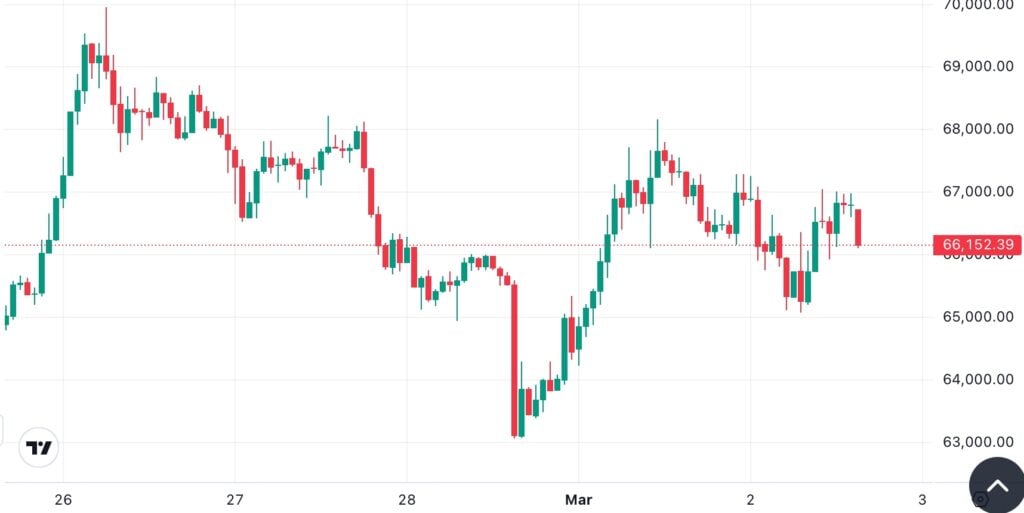
This is the part that keeps getting lost in the “digital gold” debate. Bitcoin may have long-term store-of-value believers, but in real-time geopolitical stress, traders still treat it like a high-volatility asset that can be sold quickly and bought back later.
Recoverable Is Not the Same Thing as Safe
Yes, Bitcoin can rebound. Yes, it often does. But that is not the same as being the market’s first-choice refuge.
Gold was bought because investors wanted shelter. Bitcoin was sold because traders wanted flexibility. Then, once the first fear wave faded, BTC became tradable again.
That is a very different role.
What X Is Really Telling Us
The Social Mood Was Actually Pretty Clear
The discussion on X has been unusually straightforward.
A lot of traders and macro accounts have described the split the same way: gold got the first defensive bid, while Bitcoin acted more like a liquid reaction trade. That is what made the online conversation useful this time — it was not just noise, it was mostly matching the price action.
People were not really arguing about whether Bitcoin could bounce. Most traders already know it can. The more interesting debate was whether bouncing later means the asset passed the safe-haven test in the first place.
The Market Still Sees a Difference
That distinction matters because it cuts through the marketing language.
On X, the practical conclusion looked something like this: gold was the thing investors wanted to own when they got nervous; Bitcoin was the thing traders were willing to revisit once the first panic looked overdone.
That is not an anti-Bitcoin take. It is just a more honest description of how the market behaved.
Why Gold Still Has the Stronger Hand
Gold Has a Simpler Job
Gold does not need to explain itself in moments like this. It has centuries of institutional memory behind it, lower volatility than crypto, and a built-in role in global portfolios whenever people want to reduce uncertainty.
That is why the market does not need to “believe” a new story every time gold rallies on conflict. It already knows what gold is for.
Bitcoin Still Has to Wear Two Hats
Bitcoin’s problem in this comparison is that it still has to be two things at once:
- a long-term alternative monetary asset, and
- a highly liquid risk instrument that traders actively flip in volatile conditions.
Those roles are not always compatible in the short term. And in the first hours of geopolitical stress, the second one usually wins.
That is why gold keeps looking like the cleaner safe-haven asset, at least in the opening phase of the trade.
What This Means for Traders
Gold Is the First-Order Hedge
If the goal is immediate capital preservation during a live geopolitical shock, the market is still giving a very traditional answer: gold gets the first call.
That does not mean gold is risk-free, and it does not mean it cannot correct later. It just means that when fear spikes fast, gold still attracts the most instinctive defensive demand.
Bitcoin Is Still a Second-Order Trade
Bitcoin can still matter, just in a different phase.
Once traders begin to think the first wave of selling may have gone too far, or once they start pricing in the possibility that the conflict stays contained, BTC can become attractive again. That is where its liquidity and speed start to work in its favor.
So the cleaner way to think about it is this:
- Gold is the immediate hedge.
- Bitcoin is the fast repricing trade that may come after.
That framework is a lot more useful than trying to force them into the exact same role.
For traders, the real edge is understanding which phase of the move you are in. If you are navigating these fast shifts, staying close to live market sentiment matters. You can follow broader crypto and macro rotation on Tapbit, open an account through Tapbit Register, or recover access anytime through Tapbit Password Recovery.
Final Take
What This Week Actually Proved
This latest Iran shock did not settle the gold-versus-Bitcoin argument forever. But it did give us a very clean live test.
Gold passed the immediate safe-haven test the old-fashioned way: it moved higher quickly, held up, and absorbed defensive demand right away. Bitcoin did what it often does under real stress: it sold off first, then tried to recover as traders recalculated the likely path of the crisis.
So if the question is, “In war, what does the market trust first?” the answer still looks pretty simple.
Gold gets the first call.
Bitcoin may still get the second trade.
Disclaimer: This article is for informational and educational purposes only and does not constitute investment advice. Markets can move sharply during geopolitical events, and both commodities and crypto assets carry risk.