
Updated: February 2026 | Tapbit Market Insight
At first glance, this looks like the kind of headline defense investors love.
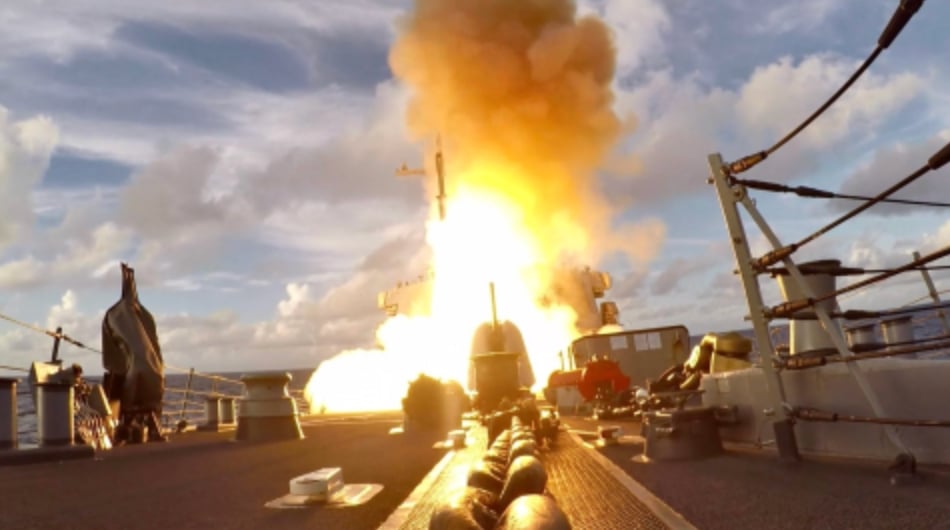
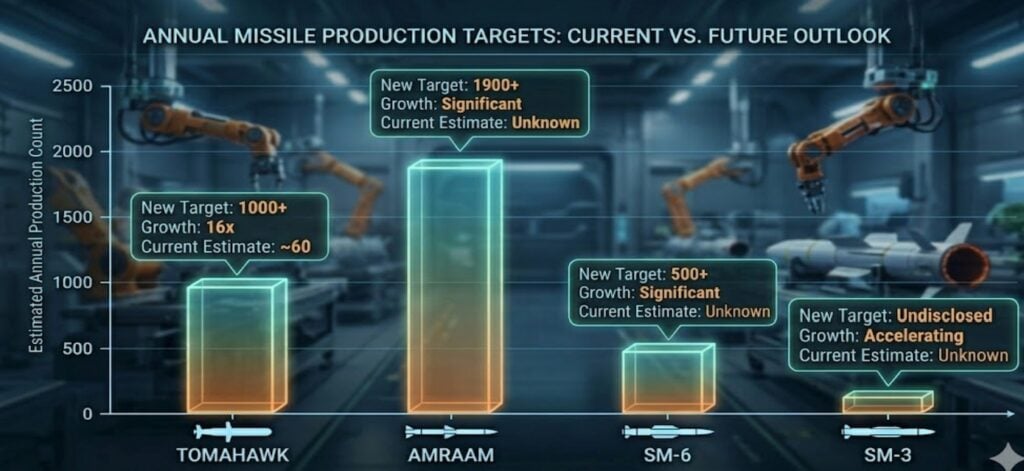
RTX, through its Raytheon business, just landed a major set of Pentagon agreements that could run as long as seven years. The goal is simple: build a lot more missiles, a lot faster. Reuters reported that Tomahawk production is expected to jump from roughly 60 a year to more than 1,000. AMRAAM output is set to reach at least 1,900 annually. SM-6 production is also being pushed sharply higher.
That is obviously a big deal.
But if you stop at “RTX got a huge contract,” you are missing the more interesting part.
To me, this is not really just a contract story. It is a story about how Washington is starting to treat defense contractors differently. The government is not just buying weapons anymore. It is trying to push companies like RTX to behave more like strategic production partners — maybe even quasi-industrial policy tools — instead of just large public companies optimizing around margins and shareholder returns.
This Is Bigger Than a Backlog Headline
Sure, the backlog matters. Of course it does. Bloomberg reported RTX’s backlog is already above $250 billion, with over $100 billion in defense. That gives investors a lot of visibility.
But what stands out to me is not just the size of the order book. It is the structure of the deal.
Seven-year framework agreements are not normal “nice quarter, nice order” type wins. They tell suppliers: we are giving you enough demand visibility that you now have very little excuse not to invest. Expand the lines. Lock in suppliers. Hire. Train. Fix bottlenecks. In other words, the Pentagon is not just placing orders — it is trying to force capacity into existence.
That changes the relationship. In the old model, a contractor won because it had the right product. In this model, a contractor wins because it can prove it can scale.
Trump Didn’t Just Help Create the Tailwind — He Also Raised the Pressure
This is the part that makes the story less clean than it looks.
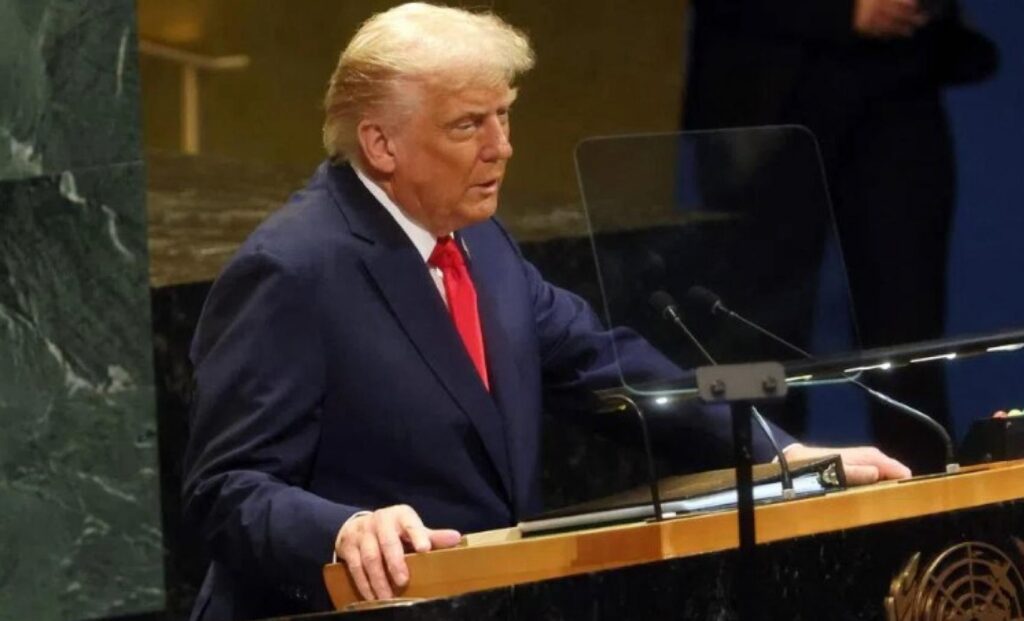
Bloomberg reported that these deals came only weeks after President Trump called RTX the “least responsive” major defense contractor.
That matters, because it tells you this was not just a quiet procurement process playing out in the background. There was political heat here. And that heat has not really gone away.
Bloomberg followed up later in February saying the Pentagon believes RTX has improved on a key missile program, but still is not where officials want it to be.
So yes, RTX got the contract. But it also got something else: a much brighter spotlight. That is why I do not read this as a simple “problem solved” moment. I read it as “demand secured, expectations raised.”
The U.S. Is Basically Telling Defense Companies to Build More and Financialize Less
This is where the whole thing gets more interesting from an investing perspective.
Reuters reported in early February that the Pentagon was preparing to curb payouts at some defense contractors under a Trump order, forcing companies that lag in performance to submit board-approved remediation plans. Reuters also reported in January that Trump said he would not allow dividends or buybacks for defense contractors until they fixed production issues.
If you are a shareholder, that should get your attention.
Because the message coming out of Washington is pretty clear: in this environment, defense companies are expected to prioritize production and reinvestment over the usual shareholder-friendly playbook. That does not mean RTX suddenly becomes unattractive. Far from it. But it does mean the old “defense prime as stable cash machine” thesis is evolving. This may still be a great business. It just may be a business with less freedom to behave like a classic mature industrial.
What People on X Are Actually Arguing About
And honestly, this is exactly why the conversation on X has been more interesting than the headline itself.
On the defense side of X, the reaction has been pretty straightforward: this is a long-overdue move, the U.S. needs more munitions, and Raytheon is finally being pushed to scale. Defense News amplified that framing directly when it posted about Raytheon ramping missile production after Trump pressure.
But investor chatter has been more mixed.
That is because the market is not really asking whether the demand is there. Everyone already knows the demand is there. The debate is whether RTX can actually turn that demand into real throughput without getting tripped up by suppliers, labor, execution drag, or plain old industrial complexity. Barron’s pointed out that RTX shares actually fell after the announcement, even with all the eye-catching missile targets. The market is not doubting the order book. It is doubting the conversion.
If I had to summarize the X mood in one sentence, it would be this: the bulls are focused on backlog, the skeptics are focused on whether backlog can become output fast enough under political pressure.
Chris Calio’s Tone Also Tells You a Lot
One detail I think people should pay more attention to is how management is talking about this.
Barron’s noted that RTX CEO Chris Calio emphasized the importance of partnership between industry and government in supporting defense readiness. That sounds polite and corporate, but read between the lines and it says a lot.
RTX management understands this moment is not just about winning more work. It is about staying aligned with Washington’s priorities at a time when the Pentagon wants output, urgency, and visible progress. That is a very different dynamic from just defending margin guidance on an earnings call. It also means management is being asked to do something harder than taking orders: prove the company can act like a scalable industrial partner under national-security pressure.
The Bull Case Is Still There — It’s Just Different Now
To be clear, I am not bearish on the setup just because the politics are getting heavier.
The fundamental bull case still makes sense:
- huge backlog,
- multi-year defense visibility,
- exposure to some of the Pentagon’s most urgent munitions categories,
- and diversification through Pratt & Whitney and Collins Aerospace.
That last point matters. RTX is not a one-dimensional missile trade. It still has a commercial aerospace business that can help smooth things out if defense execution gets noisy. So yes, this can still be a powerful multi-year story if management executes well.
But I think the reason people buy RTX is changing.
It used to be a straightforward “high-quality defense and aerospace blue chip” story. Now it is increasingly becoming a bet that RTX can handle a more interventionist Washington and still deliver. That is a more political, more operational, and frankly more complicated thesis.
The Real Risk Is Not Demand. It’s Execution.
At this point, I do not think the market is seriously worried about whether the Pentagon wants more missiles. That part is obvious.
The real risk is whether RTX can actually convert all this into results.
And that is where things get harder. It is easy to announce a target. It is much harder to build more motors, secure components, expand test capacity, keep suppliers in line, and hire enough skilled labor without something slipping.
That is why I think the next phase of the RTX story will be decided less by new contract headlines and more by whether the company can show real production progress quarter after quarter. If it can, the stock probably deserves to keep working. If it cannot, then even a giant backlog will start to look less like a moat and more like a promise it still has to prove.
My Take: RTX Is Becoming a Proxy for U.S. Industrial Readiness
This is really the big idea for me.
RTX is no longer just another defense name with good exposure. It is increasingly becoming a market proxy for whether the U.S. can still rebuild hard-power manufacturing depth through its incumbent primes. That makes the company more strategically important, which is good for long-term demand. But it also means the company may be less free to behave like a normal public company optimized purely for shareholder returns.
And that is the trade-off investors need to understand:
- the closer RTX gets to the center of U.S. rearmament strategy,
- the more durable demand likely becomes,
- but the more Washington may expect it to act like a strategic asset rather than just a listed corporation.
That is not automatically negative. In fact, it could be very bullish if the company executes well. But it is definitely not the old defense-stock playbook anymore.
Final Take
The simple version of this story is that RTX won a major missile-production deal.
The more honest version is that RTX is being pulled into a new era where industrial capacity itself has become part of the product — and where Washington is increasingly willing to pressure contractors to deliver faster, invest more, and behave differently.
RTX is not just selling missiles now. It is being asked to prove that the U.S. defense industrial base can still scale when it matters. If RTX pulls that off, the upside is not just higher revenue. It is a deeper strategic premium the market may not have fully priced in yet. If it does not, then all this backlog and all these long-term deals will start to look a lot less comforting.
And to me, that is the real RTX story in 2026.
Track market-moving narratives and stay ahead of fast-moving macro themes with Tapbit.
Disclaimer: This article is for informational and educational purposes only and does not constitute investment advice. Defense stocks can be affected by policy, execution, procurement timing, and geopolitical developments.