
The infrastructure securing the Ethereum network is undergoing a massive structural shift. While the total value of staked Ether (ETH) continues to break historical records in early 2026, the concentration of that staked capital among a few centralized providers remains a core vulnerability for the blockchain.
Ethereum co-founder Vitalik Buterin is now directly addressing this centralization bottleneck. In a major move to lead by example, the Ethereum Foundation (EF) recently deployed 72,000 ETH into the staking contract using a simplified infrastructure model known as DVT-lite.
Buterin’s ultimate goal is ambitious but necessary: reduce the friction of running an Ethereum validator down to a simple “1-click” process, allowing institutions to participate directly in network security without relying on third-party monopolies. Here is a breakdown of the DVT-lite upgrade and what it means for the future of Ethereum staking.
1. The Bottleneck: Why Institutions Avoid Solo Staking
To understand the significance of Buterin’s latest push, we have to look at the current risks associated with native Ethereum staking.
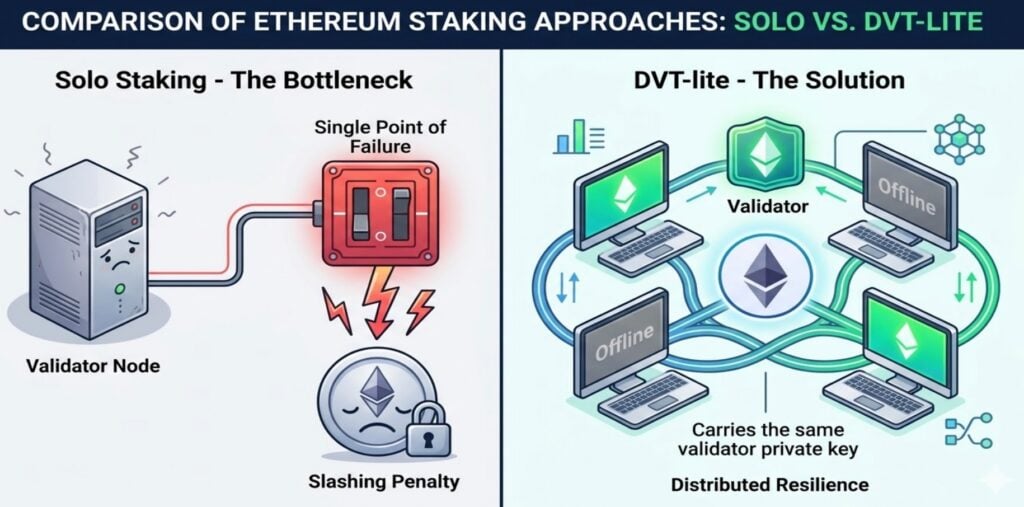
Running a standard solo validator requires technical proficiency and a dedicated hardware setup. More importantly, the current model suffers from a critical single point of failure: if a solo staker’s single machine crashes, loses internet connection, or gets hacked, the network penalizes them through a mechanism called “slashing,” resulting in a loss of their staked ETH.
Because institutions and high-net-worth entities cannot afford this operational risk, they naturally default to delegating their ETH to massive, centralized liquid staking providers or enterprise node operators. This dynamic actively harms Ethereum’s core ethos of decentralization.
2. The Solution: Enter DVT-lite
To combat this, the Ethereum Foundation utilized Distributed Validator Technology (DVT)—specifically a streamlined version called DVT-lite—to stake its 72,000 ETH in late February 2026.
DVT effectively splits the duties of a single validator across multiple machines or operators.
- How DVT-lite Works: Instead of complex key-splitting coordination, DVT-lite allows a user to configure several different computers to share the exact same validator key.
- Automated Failover: If the primary computer goes offline due to a hardware failure or network outage, another machine in the cluster instantly takes over. This structural redundancy drops the risk of network downtime and slashing penalties to near zero.
3. The Vision: “1-Click” Institutional Staking
Buterin noted that the notion of “running infrastructure” being too complex is fundamentally anti-decentralization and must be dismantled.
His vision for DVT-lite is to make distributed staking “maximally easy and one-click” for large capital allocators. Instead of hiring a team of DevOps engineers, an institution would simply choose which hardware machines will run their nodes, create a single shared configuration file, and execute a Docker container or Nix image. From there, the networking setup, peer discovery, and distributed key generation happen entirely automatically.
By removing the technical friction and the slashing risk, the Ethereum Foundation expects more institutions holding large treasuries of ETH to pull their capital out of centralized staking pools and run their own resilient DVT-lite clusters.
4. The 2026 Staking Landscape
The demand for yield on Ethereum remains structurally massive. According to March 2026 network data, there are currently over 37.5 million ETH staked, representing roughly 31% of the entire circulating supply and commanding a valuation of over $76 billion.
The appetite from validators is so high that the network’s entry queue currently holds 3.2 million ETH with an estimated wait time of 55 days, while the exit queue remains nearly empty with a wait time of only 12 hours. As DVT-lite rolls out, we can expect this institutional demand to distribute much more evenly across the network, strengthening Ethereum’s security baseline.
5. Frequently Asked Questions (FAQ)
What is “slashing” and how does DVT-lite prevent it?
Slashing is a severe network penalty where a validator loses a portion of their staked ETH due to malicious behavior or prolonged downtime. DVT-lite drastically mitigates downtime-related slashing by allowing multiple machines to share a single validator key. If the primary node crashes, a secondary machine instantly takes over, ensuring continuous uptime and eliminating the single point of failure.
Do I still need 32 ETH to use the “1-click” DVT-lite system?
Yes. Native solo staking on the Ethereum network still requires a minimum deposit of 32 ETH per validator node. Buterin’s 1-click DVT-lite vision is primarily targeted at institutions, enterprise treasury managers, and high-net-worth individuals looking to deploy large amounts of capital securely. Retail investors with smaller holdings will likely continue to rely on exchange-based staking or Liquid Staking Tokens (LSTs).
Why is the Ethereum Foundation staking 72,000 ETH right now?
The Ethereum Foundation is deploying this capital as a massive, live-network experiment. By actively testing the DVT-lite architecture with its own treasury on the mainnet, the Foundation aims to prove the infrastructure’s operational viability and reliability to skeptical institutional players, ultimately pushing the ecosystem toward greater decentralization.
Will DVT-lite replace Liquid Staking providers like Lido?
Not entirely. While DVT-lite removes the severe technical barriers for institutional solo staking, centralized and decentralized liquid staking providers still offer the massive benefit of liquidity—allowing users to trade and borrow against their staked ETH receipt tokens in DeFi protocols. However, widespread adoption of DVT-lite is expected to significantly reduce the market dominance of these top-heavy providers, distributing Ethereum’s base-layer security much more evenly.
Execute Your ETH Strategy on Tapbit
As Ethereum’s infrastructure becomes more decentralized and resilient, ETH cements its position as the foundational settlement layer of Web3. Whether you are accumulating ETH for long-term holding or trading the volatility of the Layer-2 ecosystem, execution speed is paramount.
Tapbit provides the institutional-grade matching engine and deep liquidity required to trade Ethereum and its surrounding ecosystem without friction.
- ➡️ Ready to trade the ETH ecosystem? Register your free Tapbit account today to access top-tier spot and derivatives markets.
- ➡️ Already positioned? Log in to Tapbit to analyze the real-time ETH/USDT order books and refine your macro strategy.
- ➡️ Explore the platform: Visit the Tapbit Homepage to discover our advanced charting tools and industry-leading Earn products.
Disclaimer: This article is for educational and informational purposes only and does not constitute financial advice. Cryptocurrency markets carry extreme risk. Always conduct your own due diligence before executing trades on Tapbit or any other platform.