By employing the Automated Market Maker (AMM) system, Uniswap eliminated the need for traditional order books and intermediaries, unlocking permissionless market making for everyone. This article delves into the mechanics of Uniswap, the evolving utility of its UNI token, and a balanced analysis of its potential value and inherent risks as an investment. For those interested in participating, our guide, ‘How To Get Started With Spot Trading On Tapbit,‘ provides clear instructions on how to acquire UNI on a secure and user-friendly platform.
What Is Uniswap?
Uniswap is a leading decentralized exchange operating on the Ethereum blockchain and was one of the first decentralized finance applications to achieve widespread adoption. Its core innovation is the use of an automated market maker system, which replaces the traditional order book model used by centralized exchanges. In this system, users provide liquidity by depositing cryptocurrency into paired liquidity pools, enabling others to execute seamless token swaps directly against these pools. This approach facilitates a decentralized trading experience characterized by benefits such as lower fees, faster transactions, and trustless execution without the need for an intermediary. Since its launch in 2018, Uniswap has grown to become the most popular decentralized exchange by a significant margin.
What Is The UNI Token?
The UNI token serves as the native governance and utility token for the Uniswap protocol, functioning as an ERC-20 standard token. Its primary purpose is to decentralize control by granting holders voting rights on key governance decisions, thereby enabling community-led ownership and direct influence over the protocol’s future development and management. Classified as a financial token within the DeFi ecosystem, UNI provides tools for asset management and exchange. A landmark in its distribution was the September 2020 airdrop, where 400 UNI were gifted to every Ethereum address that had previously interacted with Uniswap. This initiative not only rewarded early users but also popularized the airdrop model for token distribution and community building. The total supply of UNI is one billion tokens, which are scheduled to be distributed over four years.
How Uniswap Works
Uniswap is a decentralized exchange (DEX) that operates without traditional order books. Instead, it uses an Automated Market Maker (AMM) system powered by smart contracts on the Ethereum blockchain.
The core of this system relies on Liquidity Pools. Users, known as Liquidity Providers (LPs), deposit pairs of tokens (e.g., ETH and USDT) into these pools. In return, they receive “liquidity tokens” representing their share and entitling them to a portion of the trading fees.
Trading is governed by a mathematical formula, the Constant Product Formula (x * y = k). Here, x and y represent the reserves of two tokens in a pool, and k is a constant. When a trader swaps one token for another (e.g., buying ETH with USDT), they increase the supply of USDT in the pool and decrease the supply of ETH. This shift in the ratio automatically adjusts the price of ETH upward for the next trader. The larger the trade, the greater the price impact (slippage), which is why larger liquidity pools enable better pricing for big orders.
Is Uniswap Worth Investing?
What’s Driving The UNI Price Surge?
The price movement is primarily a reaction to the “UNIfication” governance proposal jointly introduced by Uniswap Labs and the Uniswap Foundation on or around November 10, 2025. This proposal marks a major shift in UNI’s economic model.
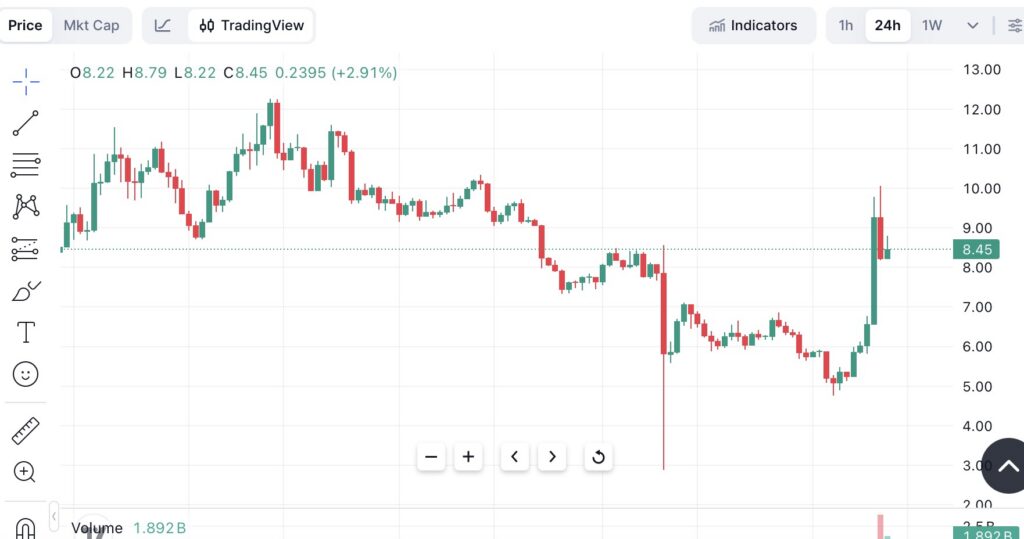
The core changes that have excited investors are:
- Activation of the “Fee Switch”: For the first time, the protocol will collect a portion of the trading fees generated on its platform. A share of these fees, along with sequencer fees from Unichain, will be used to perpetually buy back and burn UNI tokens. This creates a deflationary mechanism, reducing the circulating supply over time.
- Massive One-Time Token Burn: The proposal includes an immediate, retroactive burn of 100 million UNI tokens from the treasury, which is a significant portion of the total supply.
- Shift to a Cash-Flow Asset: This transformation addresses long-standing criticism that UNI was primarily a governance token without direct value accrual. By tying protocol revenue to token burns, UNI is positioned to become a yield-generating asset, with one analysis suggesting it could see substantial annual buyback
Potential Benefits And Key Risks To Consider
The potential benefits of the “UNIfication” proposal present a compelling bullish case, primarily by fundamentally transforming UNI from a governance token into a deflationary, cash-flow-generating asset. The activation of the fee switch, which redirects a portion of protocol fees to buy back and burn UNI, could create a powerful deflationary cycle that reduces the circulating supply and increases scarcity, especially when combined with the massive, one-off burn of 100 million tokens from the treasury. This shift is designed to directly reward long-term holders and could attract a new class of investors seeking assets with embedded yield mechanics.
However, these potential benefits are tempered by significant risks. The most substantial price surge may have already occurred, meaning the positive news could be largely “priced in,” leading to a short-term pullback, especially given the token’s extremely overbought technical indicators. Furthermore, the proposal introduces ecosystem risks, such as the potential for liquidity providers (LPs) to migrate to competitor platforms where they can earn full fees, which could undermine the protocol’s liquidity depth. Finally, the success of this initiative hinges on the decentralized governance process, which itself carries a risk of centralization if a small number of large “whale” holders exert disproportionate influence over critical decisions.
Conlusion
Investing in UNI is ultimately a strategic commitment to the future of decentralized finance—a move that demands a solid grasp of its underlying mechanics and the broader market landscape to make informed decisions. For those ready to take the next step, our guide ‘How To Register A Tapbit Account’ provides a straightforward path to begin trading on a secure and intuitive platform.
Why Choose Tapbit Exchange?
- Zero Trading Fees: Trade major pairs like BTC and ETH with no spot trading fees.
- No KYC Required: Start trading instantly without mandatory identity verification.
- Strong Security: Protected by a $50M insurance fund and transparent Proof of Reserves.
- Powerful Features: Access high-leverage futures (up to 100x), copy trading, and over 700 cryptocurrencies.
For a detailed analysis of Tapbit’s features and security measures, we recommend reading our comprehensive review: ‘Tapbit Review | Why Should You Consider Tapbit Exchange in 2025-2026?‘
Find us on: