

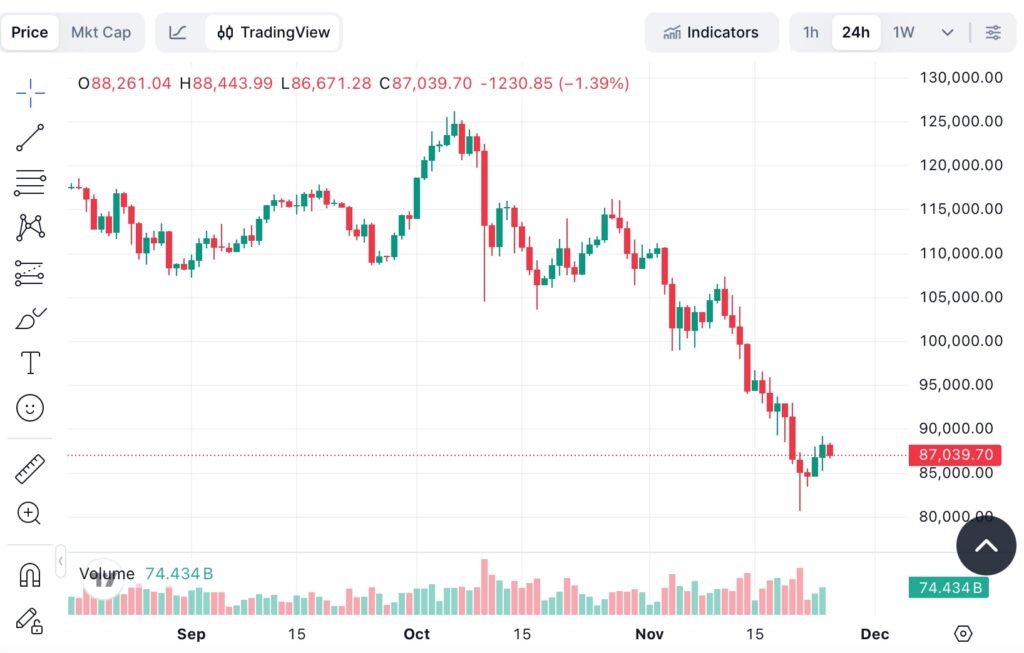
Bitcoin Rebounds to $87,789.33 on November 24, 2025—up 8.5% from last week’s lows—but massive ETF outflows cast a long shadow. U.S. spot BTC ETFs have bled a record $3.5 billion+ in November (on track to surpass February’s $3.56B), led by BlackRock’s IBIT ($2.2B out, including a $523M single-day record on Nov 19). This reversal from October’s $24B inflows follows the recent government shutdown’s end (, fueling lingering liquidity fears.
For traders, the setup remains fragile: sharp moves, thin liquidity, and high risk. Tapbit provides the precision tools needed—zero trading fees, up to 100x leverage, and real-time alerts—to navigate this volatility safely.
The Outflow Onslaught: Breaking Down November’s $3.79B Drain
November’s ETF saga reads like a horror story for bulls. Data from SoSoValue shows 11 spot BTC funds posting near-daily redemptions, with a single-day peak of $903 million on November 20—the second-worst since January 2024 launches. BlackRock’s IBIT alone shed $1.43 billion over five days ending November 19, flipping from seven straight months of inflows totaling $24.93 billion.
Grayscale’s GBTC and Fidelity’s FBTC followed suit, with $199 million and $200 million outflows on November 21, per Bloomberg. Ethereum ETFs fared no better, leaking $261.6 million on November 20 and $837 million over early November. In contrast, newer Solana (SOL) and XRP ETFs bucked the trend, netting $531 million and $410 million inflows, respectively—hinting at altcoin rotation amid BTC fatigue.
Why the bleed? NYDIG’s Greg Cipolaro points to reversed demand: Stablecoin supply dipped 5%, corporate treasury trades (like DAT share premiums) flipped to discounts, and institutions trimmed exposure post-October’s AI-tech bubble fears. The government shutdown, echoing 2018-2019’s market bottom, has eroded confidence, favoring safe-haven assets over risk-on crypto. Result? BTC’s worst month since June 2022, down 15.2%+ monthly.
Technical Indicators: Oversold Signals In A Shallow Liquidity Pool
Zoom into the charts, and the fragility sharpens. BTC’s RSI sits at 28.04 while MACD shows a bullish crossover amid rising volume (up 20% daily). Support at $85,000 held last week, but thin liquidity means even $500 million outflows can swing prices 5%+, per 24/7 Wall St. analysts. The $100,000 Fib 1.618 resistance looms as a psychological wall, untested since October’s peak.
Ethereum (ETH) at $2,880 mirrors this: Key supports at $2,700 must hold to avoid deeper slides, with institutional outflows amplifying downside risks. Altcoins like SOL ($131.60, +16 days inflows) offer diversification, but the broader $3.3T market cap remains vulnerable to U.S. macro shocks.
Expert voices vary: GSR’s Frank Chaparro warns newer retail holders may panic-sell, extending downside, while OranjeBTC’s Joshua Levine sees long-term institutions holding firm. Bitcoin Archive on X suggests these outflows could cap a bottom, akin to heavy inflows marking peaks.
Broader Market Implications: Capital Flight Or Buying Opportunity?
These outflows aren’t isolated—they signal capital flight. Stablecoin dips and DAT reversals confirm reduced liquidity, per NYDIG, potentially curbing risk appetite into year-end. Yet, history favors bulls: Eight-day outflow streaks have bottomed markets before, and cumulative ETF inflows still top $57.4 billion (6.5% of BTC’s cap).
A December rate cut could flip the script, boosting BTC toward $95,000 short-term. But with shallow liquidity and altcoin rotations (XRP +12% to $2.48), the setup feels precarious—like a house of cards in a gusty wind.
Predictions: Navigating The Fragility With Tapbit’s Edge
As Bitcoin hovers at $87,789 on November 25, 2025—with RSI dipping to 28 (oversold) and MACD locked in a bearish negative zone—the rebound feels more like a temporary truce than a full recovery. For traders, timing is everything: Scalp oversold bounces with tight stops at $85K, or hedge via alt rotations like SOL’s 19-day inflow streak ($531M total).
Tapbit equips you with zero spot trading fees, up to 150x leverage, and real-time alerts—log in to turn these outflows into calculated opportunities.