

When superpowers go to war, traditional financial anchors are usually the first things to break.
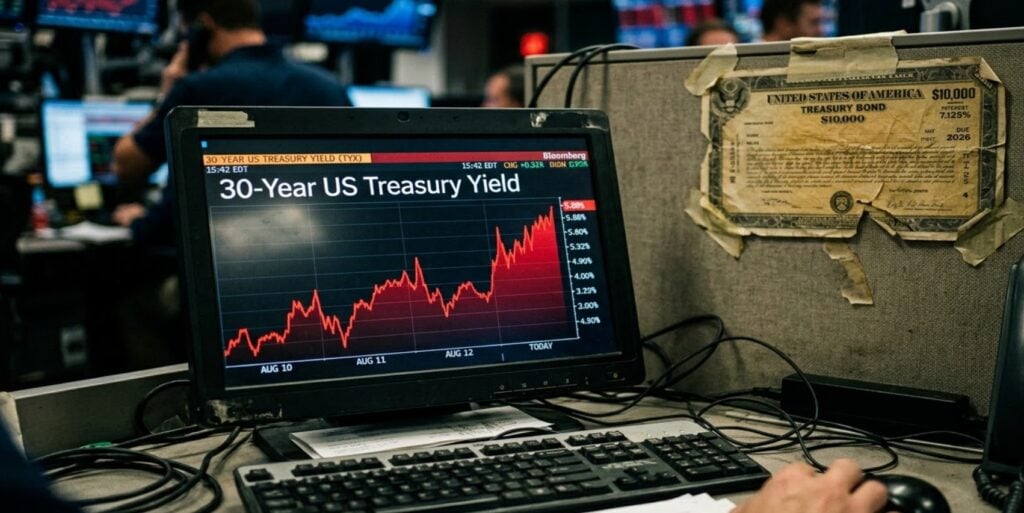
In late February 2026, the sudden escalation of the US-Iran conflict triggered an immediate and brutal “deficit panic” across global fixed-income markets. Terrified by the prospect of unconstrained military spending, investors are aggressively dumping long-term government debt. By Friday, this mass exodus pushed the 30-year U.S. Treasury yield to nearly 4.90%—a violent upward repricing that effectively wiped out every inch of profit the bond market had scraped together this year.
For Web3 investors and macro traders executing strategies on Tapbit, ignoring the bond market is a critical mistake. Sovereign debt dictates global liquidity. Here is the breakdown of why traditional fiat assets are fracturing under the weight of war, and exactly how this capital rotation is setting the stage for the cryptocurrency market.
The Fiscal Black Hole: Financing a War on Empty Pockets
The spike in long-end yields is not a temporary glitch driven by headline fear. It is a structural repricing of U.S. government credibility. Wall Street is waking up to a harsh mathematical reality: you cannot fund a massive overseas conflict while already running record deficits without triggering severe inflation.
The U.S. Treasury is currently trapped in a perfect fiscal storm:
- The $50 Billion Blank Check: The U.S. Congress is actively debating up to $50 billion in emergency military funding. Because the government has not outlined long-term cost estimates for this conflict, the bond market is pricing in a worst-case scenario: infinite debt issuance.
- A Trillion-Dollar Deficit: Even before the Middle East conflict escalated, the U.S. budget deficit had already hit a staggering $1 trillion for the five-month period ending in February.
- Evaporating Revenue: Compounding the crisis, a recent Supreme Court reversal regarding trade tariffs just wiped out tens of billions of dollars in projected federal revenue. The government has drastically less money coming in at the exact moment it needs to fund a military campaign.
“This is happening at an inflection point for tariff revenue—and tariffs themselves are inflationary, and so is war. This will only worsen the deficit problem,” noted Matt Eagan, a portfolio manager at Loomis, Sayles & Co., which oversees more than $430 billion in assets.
When a government loses tax revenue during a war, its only out is to aggressively print and borrow. Investors have made their stance clear: they are flat-out refusing to bankroll this conflict unless 30-year yields break above the 5% threshold.
Stagflation and the Synchronized Bond Strike
This deficit panic is highly contagious. The pain is not isolated to Wall Street; long-end government bonds from the UK to Japan are facing the exact same downward pressure.
The macro data points directly to stagflation—a toxic mix of high inflation and stalling economic growth. As the conflict threatens vital oil arteries in the Middle East, energy prices are surging. This is reflected directly in the bond market: 30-year Treasury Inflation-Protected Securities (TIPS) yields jumped 7 basis points this week alone. Meanwhile, short-term yields are falling as the market braces for a broader economic slowdown.
Global governments simply lack the fiscal runway to absorb these shocks. European nations are repeating the playbook of the 2022 energy crisis, trapped between ramping up defense spending and subsidizing household energy bills. In Asia, countries like Japan, Australia, and Singapore are pushing defense budgets to record highs.
The Web3 Pivot: Digital Scarcity vs. Fiat Debasement
How do you trade a global bond market meltdown?
Historically, rising Treasury yields act as a headwind for risk assets. When risk-free rates go up, capital typically drains from speculative tech and crypto. But the 2026 market structure is presenting a drastically different narrative.
Yields are not rising because the economy is booming; they are rising because investors are terrified of unchecked government borrowing and the inevitable debasement of fiat currency. As 30-year government bonds lose their historical status as a “safe haven,” institutional capital is being forced to look for alternative stores of value.
Assets with absolute, mathematically verifiable scarcity—specifically Bitcoin (BTC)—are increasingly being utilized as asymmetric hedges against sovereign fiscal irresponsibility. When traditional fiat instruments guarantee a loss of purchasing power through inflation and endless war debt, capital naturally seeks out decentralized, hard-capped networks that cannot be diluted by politicians.
Execute Your Macro Strategy on Tapbit
As the bond market forces a global repricing of inflation and war, extreme volatility across both fiat and digital asset markets is an absolute certainty. Surviving a stagflationary environment requires moving faster than the macroeconomic shifts.
Tapbit provides the deep liquidity and zero-latency execution infrastructure necessary to navigate this chaos. Whether you are accumulating spot Bitcoin to hedge against fiat debasement or actively trading the volatility of highly-correlated altcoins during liquidity crunches, your platform needs to perform flawlessly under pressure.
- ➡️ Ready to trade the macro volatility? Log in to Tapbit to access advanced charting tools and real-time order books.
- ➡️ New to the platform? Register your free Tapbit account today and secure your portfolio against the traditional market fallout.
Disclaimer: This article is for educational and informational purposes only and does not constitute financial advice. Cryptocurrency markets carry extreme risk and are subject to rapid macroeconomic shifts. Always conduct your own due diligence and utilize strict risk management before executing trades on Tapbit or any other platform.