We see it on the order books every single day. Bitcoin chops around the upper $70k range, implied volatility spikes, and retail traders rush the options chain to buy the cheapest Out-of-the-Money (OTM) calls they can find.
They treat them like cheap lottery tickets. But here is the reality from the trading desk: when you blindly buy OTM options, you are usually just donating your premium to institutional market makers.
If you want to trade the Tapbit options chain without bleeding your account dry, you need to stop trading on “hope” and understand the brutal math behind moneyness, theta bleed, and implied volatility. Let’s break down how these contracts actually work.
The Zero Intrinsic Value Problem
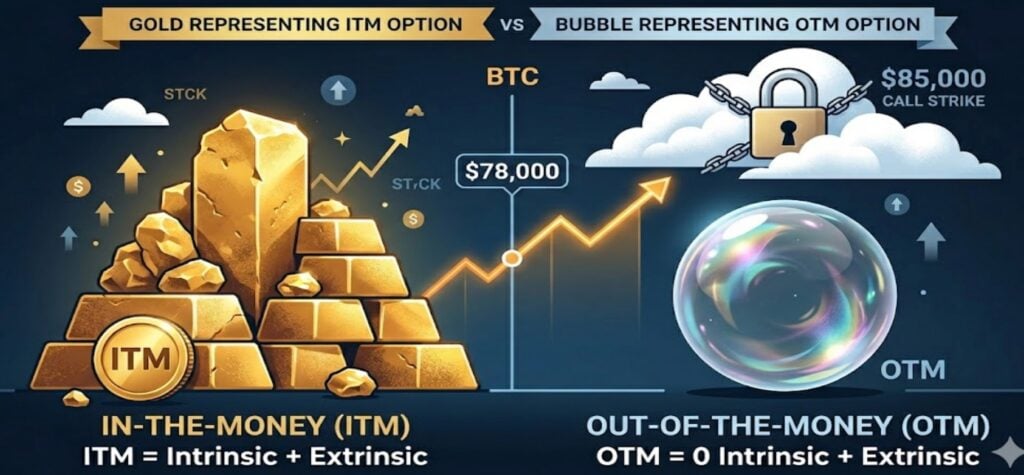
Let’s skip the textbook definitions. In options, “moneyness” just tells you if your contract is actually worth anything right now.
By definition, an OTM option has absolutely zero intrinsic value. If you exercised it right this second, you would lose money compared to just buying or selling the crypto on the spot market.
- The OTM Call: You only hold an OTM call if your strike price is higher than the current market price. If BTC is trading at $78,000, and you buy an $85,000 Call, it is deeply OTM. Exercising it means forcing yourself to buy BTC for $7,000 more than it’s currently worth.
- The OTM Put: You hold an OTM put if your strike price is lower than the current market price. If Ethereum is at $3,200 and you buy a $2,800 Put, it makes zero financial sense to exercise it and sell your ETH at a massive discount.
Why Are You Paying for a “Worthless” Contract?
If it has zero intrinsic value today, why did you have to pay $500 for it?
Because you are paying for the probability of chaos. The price of an OTM option (the premium) is made up entirely of what we call Extrinsic Value. This price tag is based on two things:
- Time to Expiration: The more time left on the clock, the higher the chance a massive crypto swing could actually push your strike price into the money.
- Implied Volatility (IV): Crypto is wild. If the market expects a massive breakout or a crash, OTM options get expensive fast. Sellers demand more money to take on the risk of that wild swing.
The Clock is Killing You (Theta)
Here is what wipes out most new options traders: time decay. When you buy an OTM option, you are fighting a ticking clock. We measure this with a Greek called Theta.
Every single day that Bitcoin just goes sideways and doesn’t move aggressively in your direction, your OTM option loses value. As you get closer to expiration, this daily bleed accelerates exponentially. If the price doesn’t cross your strike by the expiration date, the contract doesn’t just lose a little value—it vanishes. It expires worthless, and you lose 100% of the premium you paid.
This is exactly why professional desks overwhelmingly sell (write) OTM options. We rely on Theta to erode your premium day by day, and we collect the cash when the clock runs out.
Who is Actually Making Money Here?

Despite the math, OTM options are heavily traded. Here is how both sides of the market actually use them:
Why Traders Buy Them:
- Asymmetric Leverage: They are incredibly cheap compared to In-the-Money (ITM) options. You can control a massive position size for a few hundred bucks. If a black swan event happens, the ROI on a deep OTM option can be life-changing.
- Tail-Risk Hedging: Smart money buys deep OTM Puts as cheap portfolio insurance. It costs pennies, but if the market crashes 20% overnight, those cheap puts explode in value, covering the losses on their spot holdings.
Why Desks Sell Them:
- The Casino Math: The statistical reality is that the vast majority of OTM options expire worthless. Sellers take the other side of the “lottery ticket,” generating consistent yield.
- The IV Crush: Retail loves to buy OTM calls right before a major news event or economic print. But once the news drops—even if the price goes up slightly—the uncertainty leaves the market. Implied Volatility plummets. This is called an “IV Crush.” It instantly nukes the extrinsic value of the OTM option, allowing the seller to walk away with a profit even if the market moved against them.
Bottom Line
Trading OTM options requires surgical precision. You cannot just be right about the direction of the market. You have to nail the timing and the magnitude of the move. Miss on any of those three, and your contract goes to zero.
Stop trading blind. Log in to your Tapbit terminal and check the current Implied Volatility across our BTC and ETH options chains before you buy another contract. If you want to trade volatility with institutional-grade matching engines, register your Tapbit account today.
Frequently Asked Questions (FAQ)
Does an OTM option ever have intrinsic value?
No. By definition, it has zero intrinsic value. The premium you pay is purely extrinsic (time and volatility). It only gains intrinsic value if the market price crosses your strike price, officially turning it into an In-the-Money (ITM) option.
Can I make money on an OTM option if it never reaches the strike price?
Yes, but you have to sell it before it expires. If you buy an OTM call and Bitcoin suddenly spikes, the spike in Implied Volatility and Delta will pump the premium of your option. You can sell the contract back to the market at a profit without BTC ever actually reaching your strike price. But if you hold it to expiration and it’s still OTM, it’s worth nothing.
Why did my OTM call lose money even though Bitcoin went up?
You probably got hit by Theta bleed or an IV Crush. If Bitcoin goes up too slowly, the daily time decay (Theta) eats your premium faster than the price movement can add to it. Or, if the overall market volatility drops, the extrinsic value of your option collapses.