Trading on a centralized exchange is easy. But the minute you decide to step fully on-chain—whether you want to snipe a new meme coin early, farm DeFi yields, or claim an airdrop—you hit a wall. Every decentralized app (DApp) asks you to “Connect Wallet.”
Specifically, they want an EVM wallet.
At the Tapbit Security Desk, we review thousands of on-chain transactions and threat vectors every week. A few years ago, an EVM wallet was essentially just a digital lockbox for Ethereum. Today, that definition is completely obsolete. In 2026, your wallet is your multi-chain trading terminal, your decentralized identity, and, if you aren’t careful, the absolute weakest link in your portfolio.
If you are going to manage your own private keys, you need to know exactly how this infrastructure works, how Account Abstraction is changing the game right now, and how to survive the current threat landscape.
The Engine: What Exactly Is an EVM Wallet?
EVM stands for the Ethereum Virtual Machine. You can think of it as the decentralized operating system that actually processes and executes smart contracts.
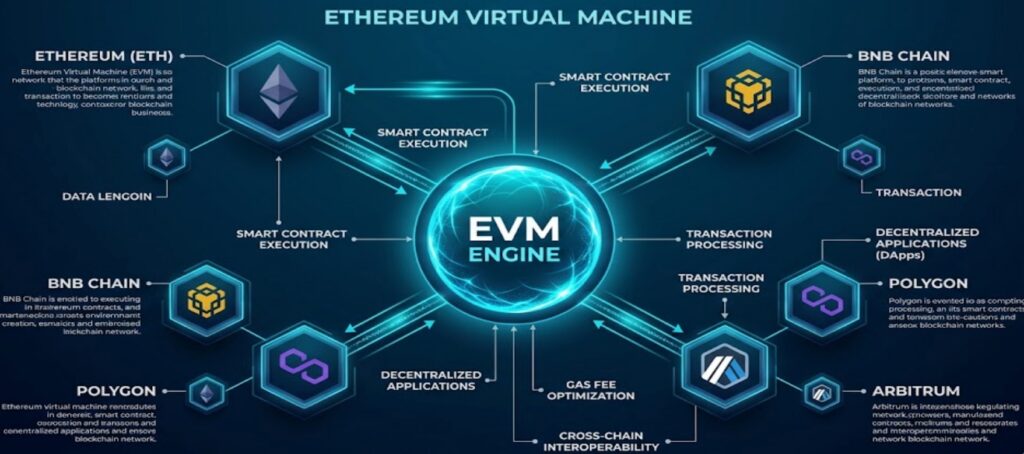
But here is the catch: Ethereum is no longer the only network running this operating system. Over the years, developers realized it was easier to copy Ethereum’s homework than start from scratch. Now, dozens of major blockchains—including BNB Chain, Polygon, Arbitrum, Optimism, and Avalanche—are “EVM-compatible.”
Because they share the exact same underlying coding language, you do not need to download 50 different apps to use 50 different networks.
An EVM Wallet (like MetaMask, Rabby, or Trust Wallet) acts as your master key. You use the exact same wallet address (starting with 0x) to seamlessly manage assets across all of these compatible chains.
When you hold your assets in one of these wallets, you are practicing “self-custody.” No bank, no institution, and no wallet developer can freeze your funds or stop your trades. You have absolute control.
The 2026 Upgrade: Account Abstraction (ERC-4337)
If you learned about crypto before 2025, the first rule drilled into your head was: “Write down your 12-word seed phrase on paper and guard it with your life.” If someone gives you that advice today, they are behind the curve.
The industry is currently in the middle of a massive infrastructure upgrade called Account Abstraction (ERC-4337). This technology upgrades your wallet from a “dumb” external address into a highly programmable smart contract. It fixes almost every major headache associated with trading on-chain.
Here is what Account Abstraction actually changes for you today:
- The Death of Seed Phrases: Next-gen smart wallets allow you to secure and recover your account using biometric passkeys (like FaceID), two-factor email verification, or “social recovery” (having three trusted friends digitally approve a wallet reset if you lose your phone).
- Gas Abstraction: We have all been there—you want to sell a token on Arbitrum, but the trade fails because you don’t have $2 worth of ETH in your wallet to pay the network “gas” fee. Account Abstraction solves this. You can now pay gas fees directly in stablecoins like USDC, or the DApp you are using can sponsor the gas fee for you.
- One-Click Trading: Instead of clicking “approve” and “sign” five different times just to stake a token in a liquidity pool, smart accounts can bundle those actions. One click, one signature, and the whole sequence executes.
The 2026 Threat Landscape: What We Are Seeing Right Now
Absolute control means absolute liability. If you sign a malicious contract, the money is gone, and there is no customer support hotline to reverse the blockchain.
Based on the real-time data we track, hackers have moved far beyond obvious phishing emails. The threats in 2026 are terrifyingly subtle.
- The “Death by a Thousand Cuts” Drainers: Hackers know that moving a million dollars sets off alarms. In January 2026, prominent on-chain investigator ZachXBT exposed a highly evasive wallet drainer campaign. The hackers compromised hundreds of EVM wallets but carefully siphoned funds in increments of less than $2,000. By keeping the theft amounts low, they managed to steal over $100,000 before the community realized it was a coordinated attack.
- Protocol-Level Exploits: Sometimes, you do everything right, but the DApp you connect to is broken. Just over a week ago, on April 13, 2026, the cross-chain protocol Hyperbridge was exploited. Attackers forged cross-chain messages to bypass the network’s Merkle proof verification, minting 1 billion bridged DOT out of thin air on the EVM gateway. The resulting crash wiped out $2.5 million. If your EVM wallet was heavily exposed to that specific bridge contract, your funds were at risk regardless of your personal security habits.
The Tapbit Defense Playbook
You are operating in a dark forest. If you are going to trade on-chain, you cannot rely on luck. You need strict operational security (OpSec). Do not just read this list—actually implement it:
- Cold/Hot Isolation is Mandatory: For your core, long-term holdings, buy a physical hardware wallet like a Ledger or Trezor. You can plug it into your computer and connect it to your MetaMask or Rabby interface. The EVM wallet acts as the screen, but the physical device holds the keys completely offline. Even if a hacker takes over your computer, they cannot move your funds without you physically pressing the button on the hardware device.
- Always Use a Burner Wallet: When you are chasing a new meme coin, clicking a link for an airdrop on X (Twitter), or trying a brand-new DApp, never connect the wallet where you keep your savings. Take 30 seconds to create an empty “burner” wallet, fund it with $50 for gas, and use that to interact.
- Revoke Your Permissions Weekly: We cannot stress this enough. Use tools like Revoke.cash. If you give a decentralized exchange “unlimited approval” to spend your USDC today, that permission stays active forever. If that exchange gets hacked a year from now, the hackers can use your old approval to drain your wallet. Revoke permissions the minute you finish your trade.
- Use Modern Wallet Simulators: Switch to transaction-focused wallets like Rabby. Before you hit “sign,” these wallets run a live simulation and explicitly tell you: “If you sign this, you will lose X tokens and gain Y tokens.” If the simulator shows an unexpected token outflow, reject the transaction immediately.
Mastering an EVM wallet takes a little time, but it is the ultimate key to true financial sovereignty. Upgrade your tools, stay paranoid, and trade safely.
Ready to scale your portfolio with secure, high-speed execution? Register your Tapbit account today. If you are already trading with us, log in to the Tapbit terminal to lock in your positions and trade safely.