Key Takeaways
- A price under $1 doesn’t automatically mean “cheap” or “undervalued” — market cap matters far more than unit price.
- This list covers both meme coins (DOGE, SHIB, PEPE, FLOKI) and utility tokens (TRX, HBAR, ADA, VET, XLM, ALGO, POL) — they operate on very different logic.
- Meme coins are driven primarily by community sentiment and social momentum; volatility cuts both ways.
- Utility tokens have clearer real-world use cases, but they remain high-volatility assets.
- Before buying, check market cap, trading volume, and what the token actually does.
- All crypto assets carry risk. Only invest what you can afford to lose.
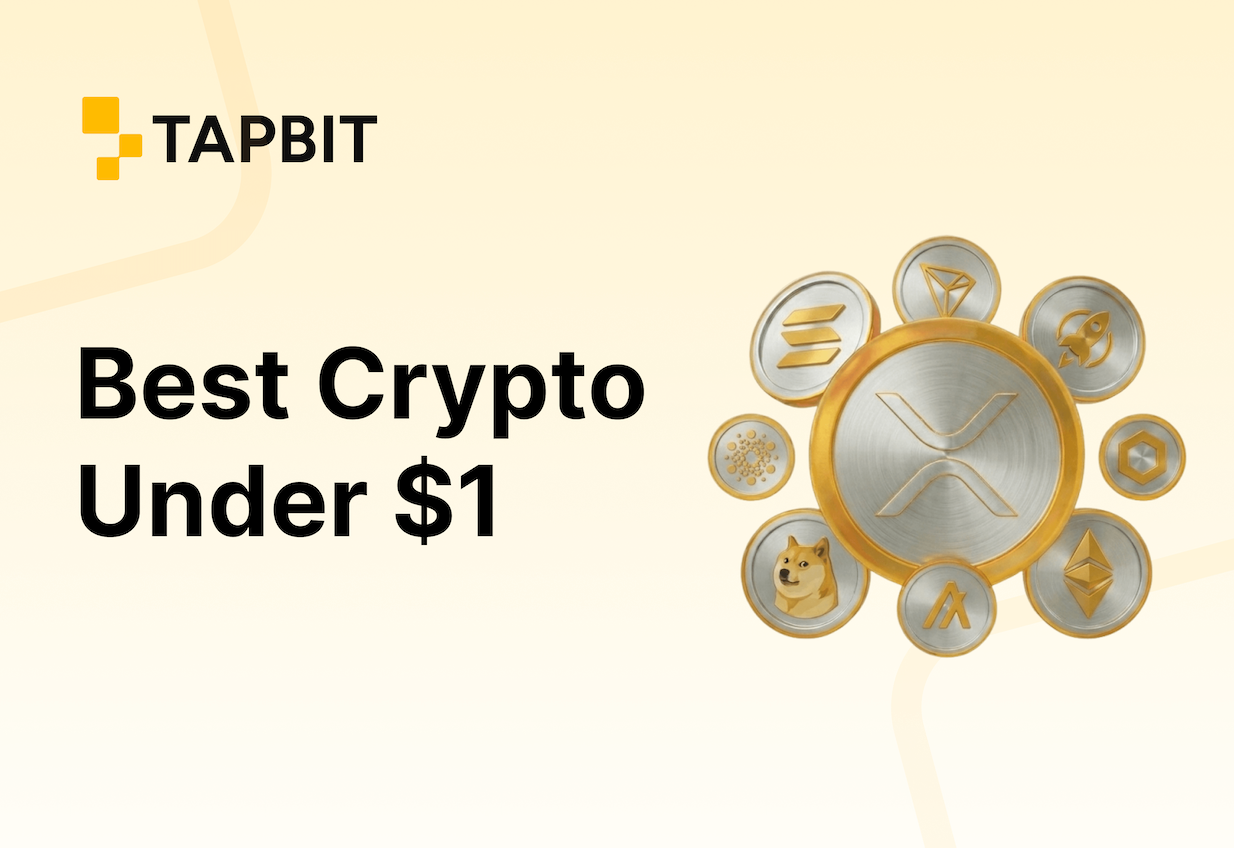
Every market cycle, new investors ask roughly the same question: what are the best cryptocurrencies under $1 right now — and are any of them actually worth paying attention to?
The honest answer is yes — but the reasons vary enormously. Some are pure meme coins driven entirely by community hype. Others are established networks with real use cases that simply still trade below a dollar. Knowing the difference is what separates a considered position from a gamble.
This article focuses on what to understand before buying any low-price token: why unit price is misleading, how to read market cap, and which signals actually matter when evaluating crypto under $1. For a detailed breakdown of all 11 tokens and how to trade them, see the full guide on the TapBit Learn.
The Most Common Mistake: Confusing Unit Price With Value
When people search for the best crypto under $1, they often assume a lower price means more room to grow. That logic doesn’t hold up.
What actually determines the scale of an asset is its market cap — the total value of all tokens currently in circulation. The formula is simple:
Market Cap = Current Price × Circulating Supply
Take Shiba Inu (SHIB) as a concrete example. Its unit price sits near zero, which looks like an easy entry. But with over 400 trillion tokens in circulation, its total market cap already runs into the billions. For SHIB to reach $1, the implied market cap would exceed the entire global economy. That’s not a realistic scenario.
The right question to ask isn’t: “How much does one coin cost?” It’s: “What is the market cap right now, and what would need to happen for the price to go higher?”
Unit price is just a number. Market cap is what you’re actually betting on. You can check real-time prices and market data on TapBit at any time, including market cap, 24-hour volume, and price history for every token on this list.
What These 11 Tokens Have in Common — and Where They Differ
The 11 tokens most commonly discussed as best crypto under $1 heading into 2026 span a wide range of risk profiles and underlying logic. Here’s how they break down:
| Token | Category | Approx. Price | Risk Level |
| DOGE | Meme Coin | ~$0.097 | High |
| SHIB | Meme Coin | ~$0.0000059 | Very High |
| PEPE | Meme Coin | ~$0.0000039 | Very High |
| FLOKI | Meme + Ecosystem | ~$0.000027 | Very High |
| TRX | Layer 1 | ~$0.324 | Medium-High |
| HBAR | Enterprise Layer 1 | ~$0.093 | Medium-High |
| ADA | Smart Contract L1 | ~$0.259 | Medium-High |
| VET | Enterprise Supply Chain | ~$0.0073 | Medium-High |
| XLM | Cross-border Payment L1 | ~$0.169 | Medium |
| ALGO | Smart Contract L1 | ~$0.114 | Medium-High |
| POL | L2 Scaling Layer | ~$0.087 | Medium-High |
Looked at as a group, they fall into three distinct categories:
Pure sentiment plays (SHIB, PEPE, FLOKI): Price is driven primarily by community heat and social distribution. There’s no quantifiable fundamental support. For these tokens, position sizing matters more than token selection. Traders looking for short-term exposure can access PEPE futures and FLOKI futures on TapBit, though leverage should be treated with particular caution given the volatility profile.
Payments and infrastructure (DOGE, TRX, XLM): These have relatively clear real-world use cases, but still face structural risks around regulation, competition, and token concentration. Low unit price does not mean low valuation. DOGE futures and TRX futures are among the more liquid contracts in this group.
Enterprise and technology adoption (HBAR, VET, ADA, ALGO, POL): These pursue more stable paths toward commercial adoption. Progress is slower, but fundamentals are more quantifiable — suited for investors who track on-chain data and partnership milestones. For those who want two-directional exposure, ADA futures and POL futures are available on TapBit.
What to Check Before Buying Any Crypto Under $1
This framework applies broadly to any low-price token you’re evaluating — whether it appears on a best coins under $1 list or you’ve come across it elsewhere.
1. Market cap, not price Always start here. A token with a $10 billion market cap needs $10 billion in new capital just to double. A token with a $200 million market cap requires far less. Market cap sets the realistic ceiling for how much upside is possible relative to the capital required to get there.
2. Trading volume and liquidity Check the 24-hour trading volume. Thin volume means that when you’re ready to sell, there may not be enough buyers at your target price — especially for smaller meme coins. A token can look attractive on paper but be extremely difficult to exit at scale.
3. Real usage vs. pure speculation For meme coins, community size, exchange listings, and social momentum are the relevant signals. For utility tokens like TRX or HBAR, check on-chain data: active addresses, daily transaction counts, stablecoin transfer volume. If there’s no activity beyond trading, treat that as a risk flag.
4. Supply schedule Is new supply being continuously issued? Is there a burn mechanism? Are large token unlocks scheduled? Each of these factors applies direct pressure on price. Many retail investors overlook supply dynamics entirely — and get caught off guard when scheduled unlocks create sustained sell pressure.
5. Your maximum acceptable loss — set it before you enter Every token commonly discussed as best crypto under $1 has experienced drawdowns of 60%–90% at various points in its history. Decide in advance the maximum you’re willing to lose on any given position. Don’t revise that number after the price has already moved against you.
Putting It All Together
Low price does not mean low risk. It does not mean high potential either. The tokens that tend to reward careful attention are the ones where market cap, real usage, and supply dynamics all point in the same direction — not just the ones with the smallest unit price or the loudest community.
Before buying any of them, return to the core questions: What’s the market cap? Is there enough liquidity? Does it have real use? Will the supply schedule create sell pressure? And how much can you afford to lose?
If you’ve done the research and are ready to get started, you can create an account on TapBit and access spot and futures markets for all 11 tokens listed here. Already have an account? Log in to check the latest prices and pick up where you left off.
For a deeper dive — including detailed breakdowns of all 11 tokens and a step-by-step guide to trading them — the full guide is available on the TapBit Learn.
FAQ
Does a low price mean better value? No. Unit price on its own is almost meaningless. This is the most important concept to grasp when evaluating any cryptocurrency under $1. A token at $0.000006 with enormous supply may already have a higher market cap than a token at $0.50 with far fewer tokens outstanding. Always check market cap first.
Are meme coins too risky for beginners? The risk is genuinely higher. Meme coins depend on sentiment, social momentum, and speculative capital rather than revenue or traditional fundamentals. They can rise sharply in a short time — but also fall 70%–90%. If you participate, only use capital you can fully afford to lose.
Why does TRX have high usage but still trade below $1? Because unit price and market cap are different things. TRX has a large total supply, so despite widespread network usage, its unit price remains below $1. That doesn’t automatically mean it’s undervalued — it’s simply how the math works at scale.
What’s the difference between DOGE and SHIB? Both are meme coins with large communities, but they’ve developed differently. DOGE has a longer history, a simpler token mechanism, clearer payment use cases, and has been formally classified as a digital commodity by the SEC and CFTC. SHIB has expanded into a broader ecosystem including DeFi tools, a Layer 2, and additional sub-projects. Neither is objectively better — they serve different roles.
Where can I read more about specific tokens and how to trade them? The TapBit Learn has a full breakdown of all 11 tokens listed here, plus a step-by-step guide covering spot trading, futures contracts, leverage, margin modes, and fee structure.
All price data sourced from CoinMarketCap, CoinGecko, and other major platforms, as of around April 17, 2026. For reference only; not investment advice. Cryptocurrency markets are highly volatile — conduct thorough research before investing.