As the cryptocurrency industry matures, the role of exchanges is undergoing a structural transformation.
What began as a largely unregulated, growth-driven market is now increasingly shaped by regulatory frameworks, compliance expectations, and institutional participation. This shift is redefining not only how exchanges operate — but also how they scale, compete, and sustain long-term growth.
Across major global markets, regulators have intensified oversight of digital asset platforms, introducing stricter requirements around anti-money laundering (AML), know-your-customer (KYC), and financial reporting standards.
At the same time, the influx of institutional capital is redefining expectations across the market, driving a convergence toward traditional financial standards. In this environment, emphasis is increasingly placed on structured risk governance, institutional-grade custody frameworks with clear asset segregation, and a higher level of regulatory accountability underpinned by auditability and transparent oversight.
This convergence of regulatory pressure and institutional standards is fundamentally transforming the role of crypto exchanges.
Rather than operating as high-growth technology platforms, exchanges are increasingly expected to function as regulated financial infrastructure—responsible not only for facilitating transactions, but for safeguarding assets, ensuring transparency, and maintaining market integrity.
From Licensing to Legitimacy: Building a Compliance-Oriented Framework
Within this evolving environment, compliance is no longer a regional requirement – it is becoming a global operational standard.
Tapbit has implemented a multi-jurisdictional compliance strategy, securing and maintaining regulatory registrations across several key markets, including the United States, Canada, and Saint Vincent and the Grenadines. These include MSB licensing, NFA registration, and related financial service authorizations, underscoring the platform’s efforts to operate within established regulatory frameworks while navigating the complexities of cross-border compliance.
However, beyond licensing, the focus is increasingly shifting toward operational compliance—ensuring that internal systems, risk controls, and reporting structures align with regulatory expectations across different markets.
Global Expansion: From Market Entry to Market Integration
As regulatory environments diverge globally, expansion strategies are becoming more nuanced.
Rather than adopting a one-size-fits-all approach, exchanges are increasingly pursuing localized growth models, combining regulatory alignment with market-specific strategies.
Tapbit’s expansion strategy reflects this shift, with growing presence and user adoption across multiple regions:
East Asia (Korea, Japan): Markets with high retail participation and strong regulatory oversight, where user trust and product reliability are critical.
South Asia (Pakistan): Emerging markets with rapid crypto adoption and increasing demand for accessible trading infrastructure.
Americas (Brazil, Argentina, U.S., Canada): Regions characterized by both institutional interest and evolving regulatory clarity.
Middle East (Dubai): A developing hub for digital assets, supported by progressive regulatory frameworks and institutional participation.
Europe (Netherlands, Italy, France, Spain): A region moving toward greater regulatory harmonization, where institutional participation is rising and compliance-driven expansion is becoming a prerequisite for long-term market positioning.
In certain markets—such as: Korea—platform adoption has been driven not only by accessibility, but by localized engagement and sustained user trust, highlighting the importance of long-term market integration rather than short-term user acquisition.
Balancing Compliance, Accessibility, and Growth
Global expansion in today’s environment requires managing a delicate balance between regulatory compliance, user accessibility, and product competitiveness—three interdependent factors that collectively determine a platform’s ability to scale globally while maintaining operational integrity and market relevance.
This creates a new operational challenge: building systems that can adapt to regulatory variation while maintaining a consistent global user experience.
Exchanges that successfully manage this balance are more likely to achieve sustainable international growth.
Product Innovation in a Regulated Environment
As compliance frameworks become more stringent, the nature of innovation within crypto exchanges is undergoing a notable shift. Instead of emphasizing rapid feature expansion alone, platforms are placing greater focus on risk-adjusted trading products, enhanced transparency in financial mechanisms, and stronger user protection frameworks—signaling a move toward more disciplined and sustainable innovation models.
This reflects a broader shift within financial markets, where innovation is expected to coexist with regulatory responsibility and user protection.
CEO Perspective: Regulation as an Enabler of Growth
According to Tapbit’s CEO, regulation is not a barrier — but a catalyst for the next stage of industry development.
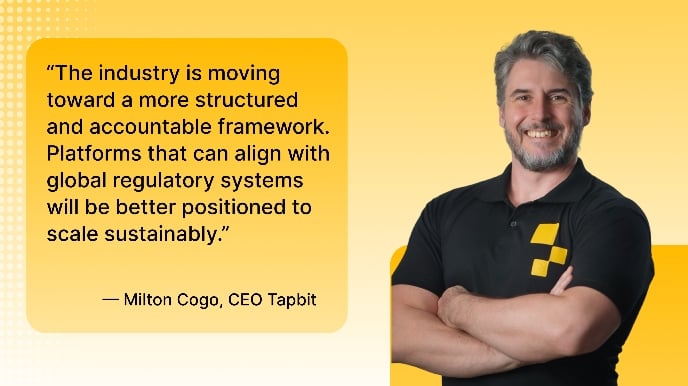
“The industry is moving toward a more structured and accountable framework. Platforms that can align with global regulatory systems will be better positioned to scale sustainably.” – Milton Cogo, CEO Tapbit
He further noted:
“Compliance should not be viewed as a constraint on innovation. Instead, it provides the foundation for trust, which ultimately enables broader adoption—both from retail users and institutional participants.”
Looking Ahead: The Next Five Years of Web3
Looking ahead, the CEO expects the next stage of Web3 to be defined by a deeper integration with global financial systems, as digital assets increasingly converge with established financial infrastructure. This transition is likely to be characterized by greater regulatory clarity across key jurisdictions, expanding institutional participation, a heightened focus on security and transparency, and the gradual emergence of hybrid financial architectures that bridge traditional finance with decentralized networks—reshaping how value is created, transferred, and managed in the years ahead.
In this context, exchanges will play a critical role as infrastructure providers connecting users, capital, and markets.
A New Competitive Landscape
As the industry continues to evolve, competitive differentiation is increasingly anchored in regulatory readiness, global operational capability, institutional alignment, and the strength of long-term compliance frameworks. Together, these factors reflect a broader transition toward infrastructure-led competition, where resilience, accountability, and strategic discipline define long-term positioning.
Platforms that can successfully integrate these elements may be better positioned to navigate both regulatory complexity and market volatility.
Conclusion
The trajectory of the crypto industry is becoming increasingly clear: a shift from rapid expansion toward regulated, globally integrated financial infrastructure.
Exchanges are no longer evaluated solely by growth, but by their ability to operate with transparency, compliance, and operational resilience.
In this evolving landscape, long-term competitiveness will depend on aligning with global regulatory standards while adapting to local market dynamics.
Platforms that can balance innovation with accountability, and scalability with regulatory discipline, are likely to stand out. As crypto converges with traditional finance, exchanges are evolving beyond trading platforms into critical financial infrastructure.
Ultimately, trust and structural integrity—not speed of growth—will define the next phase of the industry.
About Tapbit
Tapbit is a global cryptocurrency derivatives exchange positioned at the intersection of performance-driven trading infrastructure and institutional-grade risk management.
Since its inception in 2021, the platform has focused on building a robust and scalable environment for digital asset trading, integrating high-efficiency execution systems, layered risk-control architecture, and a user-centric operational framework.
Serving a growing global user base, Tapbit continues to advance its strategic vision of becoming a trusted financial infrastructure provider within the evolving digital asset ecosystem—delivering a trading environment defined by security, transparency, and operational resilience.
Connect With Tapbit
A Global Platform for the Next Phase of Web3
As the digital asset industry transitions toward greater maturity and regulatory alignment, Tapbit remains committed to fostering a platform that balances innovation with responsibility, and accessibility with compliance.
Engage with Tapbit across global channels and stay informed on platform developments, market insights, and ecosystem initiatives:
[USA, April 1, 2026] — Tapbit, a global cryptocurrency derivatives exchange, today announced the appointment of Milton Cogo as Chief Executive Officer (CEO),…